
00 · Abstract
Abstract
Interfacial rheology describes the mechanical response of an adsorption layer when a fluid interface is deformed. Unlike equilibrium surface or interfacial tension, which characterizes the free-energy cost of creating interfacial area, interfacial rheological quantities characterize how the interfacial stress changes when the layer is expanded, compressed or sheared. The response can contain both elastic and viscous contributions and is therefore generally viscoelastic. For adsorption layers formed by surfactants, proteins, lipids, polymers, particles or mixtures, this response reflects not only intermolecular interactions within the interface but also exchange of material between the interface and the adjoining bulk phases. [P1, 10, 11, 1]
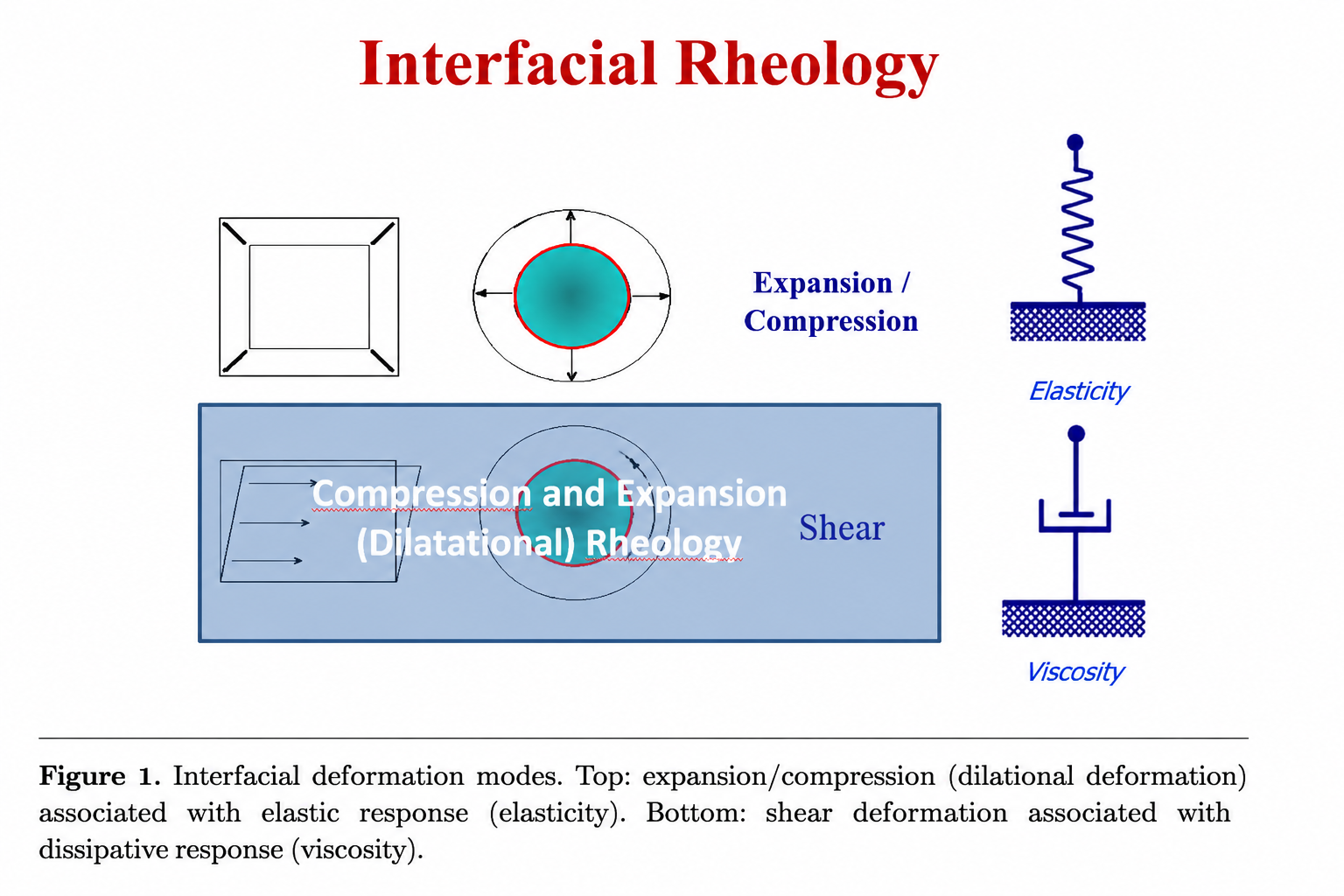
The two principal modes considered in classical interfacial rheology are dilational deformation and shear deformation. Dilational rheology changes the interfacial area and therefore perturbs the surface concentration of adsorbed species. Shear rheology changes the shape of an interfacial element at approximately constant area. The distinction is physically important because dilational deformation couples strongly to adsorption, desorption and diffusion, whereas shear deformation can probe the lateral connectivity and resistance of the interfacial layer with less direct change in surface concentration. [P1, 4, 5, 10]
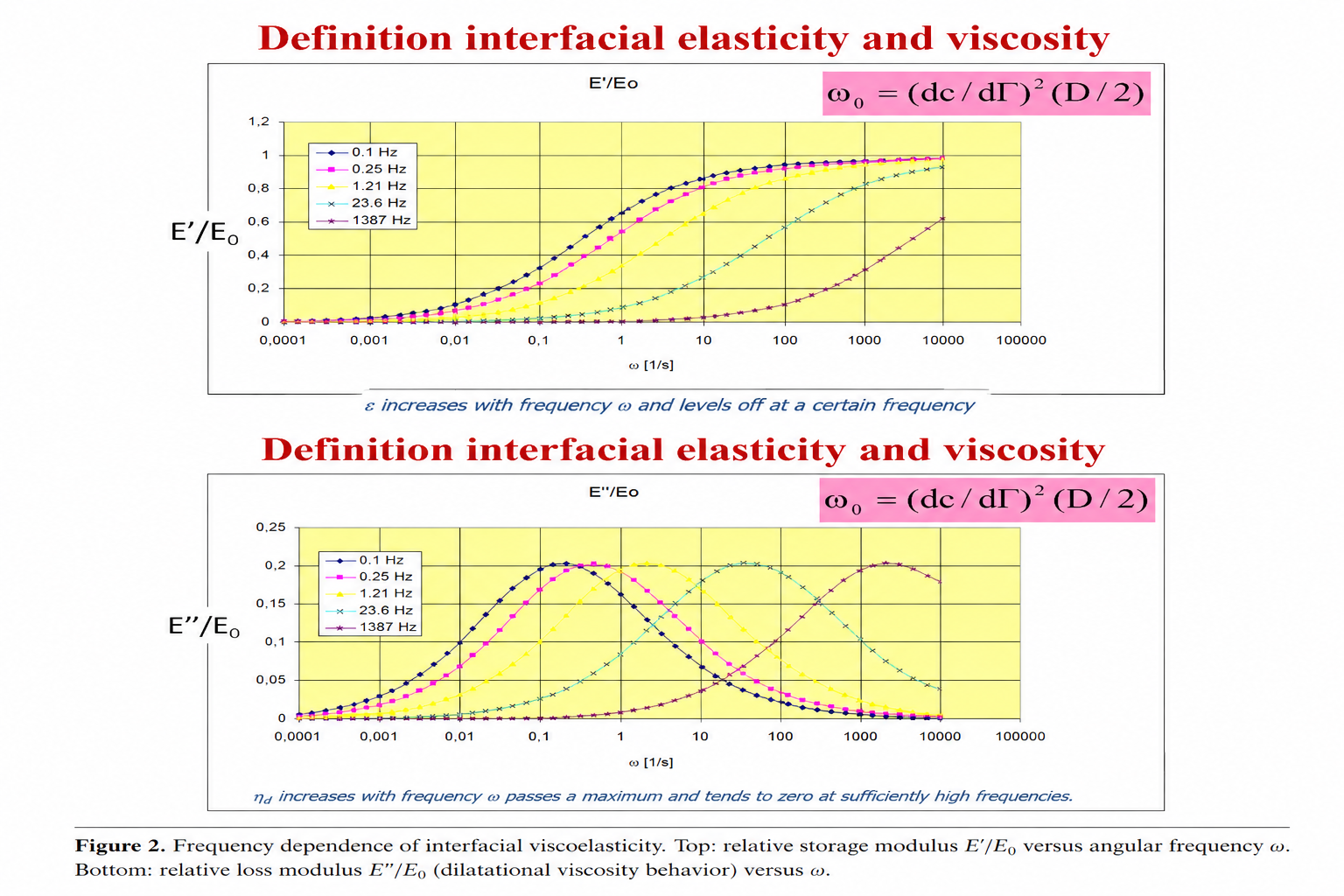
For small harmonic area perturbations, the dilational response is represented by a complex modulus. The real part is the storage component and represents the in-phase elastic response. The imaginary part is the loss component and represents the out-of-phase dissipative response. The corresponding dilational viscosity is obtained from the loss modulus divided by angular frequency. A central result emphasized in Miller lecture material is that all of these quantities depend on both interfacial composition and frequency. At low frequency, molecules can exchange with the bulk during the deformation cycle and partially restore equilibrium; at high frequency, exchange becomes progressively too slow and the response approaches the limiting elasticity of a more nearly insoluble or compositionally frozen layer. [P1, 4, 5, 2]
The classical theoretical treatment by Lucassen and van den Tempel provides the framework for understanding this frequency dependence. The dynamic modulus reflects competition between the timescale of imposed deformation and the timescale of diffusion-controlled adsorption and desorption. Consequently, the measured elasticity rises with increasing frequency toward a limiting value, while the apparent dilational viscosity pass through a maximum and decline again at sufficiently high frequency. This behavior demonstrates that a frequency-dependent interfacial viscosity is not necessarily evidence of a molecularly viscous film alone; it can emerge from coupling between interfacial thermodynamics and mass transfer. [P1, 4, 5, 2]
Experimentally, interfacial rheology spans an unusually wide range of methods. The primary source material for this review covers capillary-wave and longitudinal-wave damping, oscillating barriers, drop and bubble profile analysis, oscillating-drop and oscillating-bubble techniques, transient drop relaxation, capillary-pressure methods and torsion-pendulum shear rheometry. Slow profile-based oscillations can operate in the millihertz range, while capillary-pressure measurements with piezo-driven oscillating drops extend toward approximately 100 Hz and oscillating-bubble methods can reach still higher frequencies. For shear rheology, highly sensitive torsion-pendulum instruments are used to impose small angular deformations while minimizing disruption of fragile interfacial structures. [P1, 5, 6, 12]
This review develops the physical and experimental framework of interfacial dilational and shear rheology with particular emphasis on the concepts and methods presented in Miller's lectures and in the interfacial-rheology literature associated with Miller, Liggieri, Lucassen, Ravera, Krägel and collaborators. The central conclusion is that interfacial viscoelasticity is not a single material constant. It is the response of a particular adsorption layer at a defined composition, age, deformation amplitude and frequency. Meaningful comparison therefore requires strict control of the interfacial state and of the hydrodynamic contribution of the adjoining bulk phases. [P1, 4, 5, 10]
Keywords
Keywords
interfacial rheology; surface viscoelasticity; dilational rheology; shear rheology; surface elasticity; surface viscosity; storage modulus; loss modulus; oscillating drop; oscillating bubble; capillary pressure; Lucassen-van den Tempel; torsion pendulum; adsorption layers; surfactants; proteins; lipids [P1, 4, 5, 2]
01 · Scientific Review
Introduction
A fluid interface can possess mechanical properties that are not evident from its equilibrium tension alone. When surface-active molecules adsorb, the interface becomes a two-dimensional thermodynamic subsystem with its own composition and structure. If the interfacial area is changed, the adsorbed molecules are or compressed. If the interface is sheared, lateral structures are distorted. The resulting resistance to deformation can be elastic, viscous or a combination of both. [P1, 10, 11]
This mechanical response is referred to as interfacial or surface rheology. It is the two-dimensional analogue of bulk rheology, but the analogy must be used carefully. An interface has no unique macroscopic thickness, and its constitutive behavior can be coupled strongly to adsorption and diffusion in the adjacent phases. An apparent interfacial viscosity can therefore contain a contribution from molecular exchange between interface and bulk rather than representing only friction within a geometrically defined film. [P1, 4, 5, 1]
The Miller lecture material begins by distinguishing several generic deformation modes: expansion, compression, shear, bending and torsion. For fluid adsorption layers, the most widely studied are expansion/compression, collectively described as dilational deformation, and shear deformation. Both can yield elastic and viscous response, but they probe different aspects of interfacial organization. [P1, 10, 11, 1]
The motivation for interfacial rheology is both fundamental and practical. Adsorption layers stabilize emulsions and foams, determine the resistance of thin liquid films to local deformation, influence droplet coalescence, and participate in the mechanical behavior of biological and technological interfaces. Two formulations with similar equilibrium tension can exhibit very different stability because one forms a mechanically resilient adsorption layer while the other remains highly mobile. [P1, 1, 2, 4]
Interfacial rheology therefore extends tensiometry from the question 'what is the interfacial free energy?' to the question 'how does the interface respond when it is deformed?'. The answer depends on the deformation mode, the timescale and the degree to which molecules can redistribute. [P1, 1, 2, 4]
02 · Scientific Review
Deformation modes at fluid interfaces
2.1 Dilational deformation
Dilational deformation changes interfacial area. During expansion, a fixed number of adsorbed molecules initially occupies a larger area and the surface concentration decreases. During compression, the surface concentration increases. The resulting change in surface or interfacial tension provides the measurable interfacial stress response. [P1, 1, 2, 4]
For a soluble surfactant, the perturbation is not limited to geometric dilution or compression. Expansion lowers the interfacial concentration and can promote adsorption from the bulk; compression increases the interfacial concentration and can promote desorption. The observed response therefore depends on the rate of deformation relative to adsorption and diffusion. [P1, 4, 5, 1]
2.2 Shear deformation
Interfacial shear changes the shape of an interfacial element while leaving its area approximately unchanged. A simple shear deformation displaces neighboring regions laterally relative to one another. Because the total area does not change strongly, the response is less directly coupled to adsorption through surface concentration. It can therefore provide particularly direct information about lateral molecular networks, condensed monolayers, protein films, polymer layers and particle-laden interfaces. [P1, 10, 11, 1]
A purely fluid interface with no interfacial structure offers very little resistance to shear. Detectable shear elasticity or viscosity indicates that the adsorption layer has developed lateral interactions or a network capable of transmitting tangential stress. [P1, 10, 11, 1]
2.3 Why dilational and shear properties are not interchangeable
Dilational and shear moduli cannot generally be converted into one another. A layer can be strongly resistant to compression because molecules interact intensely when packed, yet still flow readily under shear. Conversely, a network of anisotropic or cross-linked structures can resist shear while exhibiting a more moderate dilational response. The two modes therefore provide complementary information. [P1, 10, 11, 1]
03 · Scientific Review
Interfacial stress, strain and linear viscoelasticity
3.1 Dilational strain
For small deformations, dilational strain is commonly expressed as the relative change in area, dA/A, or equivalently d ln A. The conjugate interfacial stress is the change in surface tension dγ. The differential dilational elasticity is therefore the derivative of γ with respect to logarithmic area. [P1, 1, 2, 4]
Dilational elasticity
The sign convention varies in the literature depending on whether surface pressure or surface tension is used. What matters physically is the magnitude and phase of the restoring response to area change. For a compression, surface tension commonly decreases while surface pressure increases. [P1]
3.2 Harmonic deformation
In an oscillatory experiment the area is perturbed sinusoidally around a mean value. If the perturbation is sufficiently small for linear response, the tension oscillates at the same fundamental frequency. The tension signal can differ from the area signal in both amplitude and phase. [P1, 4, 5]
Harmonic area perturbation
Harmonic tension response
The ratio of tension amplitude to relative area amplitude gives the magnitude of the complex dilational modulus, while the phase angle φ determines how much of the response is elastic and how much is dissipative. [P1, 1, 2, 4]
3.3 Complex dilational modulus
Complex dilational modulus
The real part E′ is the storage modulus and represents the component of the response in phase with deformation. It quantifies reversible storage of mechanical energy. The imaginary part E″ is the loss modulus and represents the component shifted by ninety degrees in the idealized linear decomposition. It quantifies energy dissipated during a cycle. [P1, 1, 2, 4]
Magnitude and phase
Miller lectures stress that rheological parameters are used in several equivalent pairs in the literature. One can report E′ and E″, or the modulus magnitude and phase angle, or elasticity together with an effective dilational viscosity. The important requirement is that a complete pair be reported so that the remaining quantities can be derived. [P1, 1, 2, 4]
3.4 Dilational viscosity
Dilational viscosity
The dilational viscosity η_d is therefore frequency dependent when E″ is frequency dependent. It should not automatically be interpreted as a constant intrinsic viscosity of the interfacial material. In soluble surfactant layers, a substantial part of the loss response can arise from exchange of molecules with the bulk. [P1, 4, 5, 1]
04 · Scientific Review
Molecular origin of interfacial viscoelasticity
4.1 Surface concentration and restoring stress
Consider an adsorption layer at equilibrium. A rapid expansion lowers the surface excess Γ because the same adsorbed amount is distributed over a larger area. The tension rises toward the value of a less populated interface. This creates a restoring surface-pressure gradient. If the deformation is slow, additional molecules can adsorb from the bulk and reduce the change in tension. The measured modulus therefore depends on how much molecular exchange occurs during the cycle. [P1, 1, 14]
A compression produces the reverse . The interface is temporarily enriched; tension decreases and molecules can desorb. In a perfectly insoluble monolayer, no exchange occurs and the elastic response is governed by the interfacial equation of state. In a soluble monolayer, exchange relaxes part of the stress. [P1]
4.2 Lateral molecular interactions
The equation of state itself depends on interactions between adsorbed molecules. A dilute ideal layer has a modest restoring stress, whereas a densely packed layer with strong repulsive, attractive or steric interactions can respond strongly to small area changes. Surfactant chain packing, ionic head-group interactions, protein-protein contact, lipid phase state and polymer entanglement can therefore all modify E′. [P1, 1, 14]
4.3 Dissipative mechanisms
Energy can be dissipated through several channels. Molecules can diffuse between bulk and interface, reorganize within the adsorption layer, move laterally through a viscous interfacial environment or undergo conformational changes. Bulk hydrodynamics around the oscillating interface also dissipate energy and must be separated from the interfacial contribution by the analysis model. [P1, 1, 14]
4.4 Structural relaxation
For proteins and macromolecules, adsorption can be followed by slow conformational rearrangement. An aged interface can therefore have a different rheological response from a freshly adsorbed layer even if the equilibrium tension appears nearly unchanged. Interfacial age is thus a critical state variable in rheological experiments. [P1, 1, 2, 4]
05 · Scientific Review
Frequency dependence and the Lucassen-van den Tempel concept
5.1 Competition between deformation and adsorption relaxation
The characteristic feature of interfacial dilational rheology is frequency dependence. At low oscillation frequency, each cycle lasts long enough for substantial adsorption and desorption. The interfacial composition therefore remains closer to equilibrium and the restoring tension change is relatively small. As frequency increases, exchange with the bulk cannot keep pace with the imposed deformation. The interface behaves progressively more like an insoluble layer and the elastic response increases. [P1, 4, 5, 1]
The Miller lecture material states this directly: the dynamic surface elasticity increases with angular frequency and approaches a limiting modulus at sufficiently high frequency. The limiting value corresponds to the response of the surface layer when interfacial composition is effectively frozen over the period of deformation. [P1, 4, 5, 2]
Angular frequency
5.2 Diffusion-controlled exchange
Lucassen and van den Tempel developed the classical treatment linking the complex dilational modulus of a soluble adsorption layer to diffusion in the adjoining bulk. Their theory formalizes the intuitive competition between oscillation period and diffusion time. A periodic perturbation generates an oscillating concentration field normal to the interface. The depth over which molecules can respond decreases as frequency increases. [P1, 4, 5, 1]
At low frequency, the diffusion layer extends farther into the bulk and a comparatively large reservoir can exchange with the interface. At high frequency, only molecules very close to the interface can participate during one cycle. This progressive restriction of mass exchange causes the storage component to rise. [P1, 4, 5, 2]
5.3 Characteristic response of elasticity and viscosity
The qualitative frequency dependence shown in the source material is characteristic. The elastic response E′ increases with frequency and levels off toward the limiting high-frequency modulus. The effective dilational viscosity increases over an intermediate range, reaches a maximum and then tends toward zero at sufficiently high frequency when exchange becomes too slow to contribute strongly to dissipation. [P1, 4, 5, 2]
Interpretation. A maximum in apparent dilational viscosity does not necessarily indicate a maximum in molecular friction inside the adsorption layer. In the Lucassen-type picture it can arise from the frequency at which exchange between bulk and interface is most strongly out of phase with the imposed deformation. [P1, 4, 5, 1]
5.4 Composition dependence
Frequency dependence is inseparable from composition. A weakly populated interface can exchange rapidly and have a low modulus. Near dense packing, the interfacial equation of state is steeper and the high-frequency elasticity can be much larger. Electrolyte, mixed surfactants, proteins, lipids and polymers alter both the thermodynamic elasticity and the relaxation time. [P1, 4, 5, 1]
06 · Scientific Review
Historical development of dilational rheology
6.1 Wave damping and interfacial inextensibility
One of the earliest motivations for interfacial rheology came from the observation that surface-active films damp waves. The Miller lectures cite Levich's work on damping by surface-active substances and the concept that strong damping reflects the effective inextensibility of the interfacial film. Surface concentration gradients create restoring stresses that oppose local extension and compression. [P1, 5, 6, 12]
6.2 Capillary and longitudinal waves
Wave-based techniques probe interfacial viscoelasticity through the propagation and damping of disturbances along a liquid surface. Ripple or capillary-wave methods use transverse surface waves, while longitudinal-wave methods probe compressional disturbances. Mann, Hansen, Lucassen, Noskov and others developed experimental and theoretical approaches for extracting interfacial response from wave attenuation and phase behavior. [P1, 4, 5, 1]
These methods access frequencies substantially higher than slow mechanical deformation. The source material lists approximate operating windows of 10 to 500 Hz for capillary-wave methods and 0.1 to 15 Hz for longitudinal waves. Their main challenge is that interpretation requires an accurate hydrodynamic model of wave propagation in the bulk liquid together with the interfacial constitutive response. [P1, 5, 6, 12]
6.3 Oscillating bubble methods
Kretzschmar and Lunkenheimer developed early oscillating-bubble techniques around 1970. A bubble in a controlled cell is expanded and compressed periodically, and the pressure or geometry response is analyzed. Oscillating bubbles can access a broad frequency range and are particularly attractive when gravitational deformation would complicate rapid drop-shape measurements. [P1, 4, 5, 9]
6.4 Oscillating drop and capillary-pressure methods
Passerone, Liggieri, Rando, Ravera and Ricci developed capillary-pressure approach for rapid interfacial dynamics. Small nearly spherical drops can oscillate at frequencies where direct shape fitting of each instantaneous contour becomes impractical. The change in interfacial tension is inferred from the pressure response and known curvature. [P1, 2, 7]
This strategy also solves a sensitivity problem for liquid-liquid interfaces with small density difference. A large pendant drop must be deformed by gravity for profile analysis, but a small spherical drop can be analyzed through capillary pressure even when the two phases have nearly matched densities. [P1, 2, 7]
07 · Scientific Review
Slow oscillating drop and bubble profile analysis
7.1 Measurement principle
At low frequency, profile analysis tensiometry can determine the instantaneous area and surface tension throughout an oscillation cycle. The drop or bubble volume is modulated by a dosing system, the interface contour is recorded by video, and the Young-Laplace equation is fitted to each frame. [P1, 4, 5]
Young-Laplace equation
The result is a time series of volume, area and tension. If the deformation is sinusoidal and sufficiently small, the tension response is also approximately sinusoidal. The amplitude ratio yields the modulus magnitude and the phase shift yields the viscous contribution. [P1]
7.2 Amplitude as a measure of elasticity
The source material states explicitly that the amplitude of the surface-tension oscillation provides a measure of dilational elasticity. For a fixed relative area amplitude, a stronger tension oscillation indicates a stiffer adsorption layer. [P1, 1, 2, 4]
7.3 Phase shift as a measure of viscous response
A purely elastic interface would respond without phase lag in the idealized linear limit. Real adsorption layers generally display a phase shift between area and tension. This phase shift reflects dissipative processes and provides the basis for determining the loss component and effective dilational viscosity. [P1, 1, 2, 4]
7.4 Frequency range
Conventional profile-based drop or bubble oscillations are naturally suited to low frequencies because each contour must remain sufficiently well resolved and the dosing system must control the volume accurately. The lecture overview places this regime approximately between 0.001 and 0.1 Hz. Such frequencies are valuable for slow adsorption layers, proteins and long relaxation processes. [P1, 1, 14]
7.5 Advantages and limitations
The principal advantage is simultaneous direct observation of interface geometry, area and tension. The method is conceptually transparent and can be applied to both liquid-gas and liquid-liquid interfaces. The principal limitations are frequency, the need for sufficient gravitational deformation, and the requirement that oscillation amplitude remain within the linear response regime. [P1, 4, 5]
08 · Scientific Review
Fast oscillating drops and capillary-pressure rheology
8.1 Why profile analysis becomes insufficient at high frequency
At higher frequencies the drop cannot necessarily be imaged and fitted with adequate temporal resolution, and a small rapidly oscillating drop remains nearly spherical. Capillary pressure then becomes the more sensitive observable. If curvature is known, rapid pressure changes can be converted into tension changes. [P1, 2, 7, 9]
8.2 Piezo-driven oscillations
Miller lectures describe a piezo-driven oscillating drop/bubble system developed as additional equipment for a profile-analysis tensiometer. The piezo element drives rapid volume oscillations, while a pressure sensor monitors the resulting capillary-pressure response. The cited operational range is approximately 0.1 to 100 Hz, with the possibility of still higher frequencies depending on configuration. [P1, 2, 7, 9]
This frequency extension is scientifically important because the response of soluble surfactant layers can change strongly between the millihertz and tens-of-hertz regimes. Combining slow profile oscillations with high-frequency capillary-pressure oscillations can therefore map a much larger part of the interfacial relaxation spectrum. [P1, 4, 5, 1]
8.3 Small density differences
Capillary-pressure methods are particularly useful at liquid-liquid interfaces where the density difference is too small to produce a strongly deformed pendant drop. The lecture material explicitly identifies this geometry as a strength of the method. Fast dynamic studies are therefore possible even in systems that are poorly conditioned for conventional profile analysis. [P1]
09 · Scientific Review
Transient relaxation methods
9.1 Step deformation
Interfacial viscoelasticity need not be measured only by harmonic oscillation. In a transient experiment the interfacial area is changed rapidly and then held at a new value. The subsequent relaxation of surface tension is recorded. The relaxation reflects redistribution of molecules within the interface and exchange with the bulk. [P1, 4, 5, 8]
9.2 Drop relaxation
Miller lectures cite the drop-relaxation method developed by Miller, Sedev, Schano, Ng and Neumann in the early 1990s. A rapid deformation generates an initial stress, and the return toward equilibrium is analyzed in the time domain. Such experiments are particularly useful when a broad relaxation spectrum makes a single-frequency oscillation insufficient. [P1, 4, 5]
9.3 Relation between transient and frequency-domain response
For a linear time-invariant system, transient relaxation and harmonic response contain equivalent information in principle. A broad relaxation function can be transformed into a frequency-dependent complex modulus. In practice, finite measurement time, noise and nonlinearity make each approach sensitive to different features. [P1, 4, 5, 8]
10 · Scientific Review
Experimental examples and concentration effects
10.1 Nonionic surfactants
The source material includes typical dilational-rheology data for nonionic surfactants such as ethoxylated surfactants. Their response varies strongly with concentration because the surface equation of state and the rate of exchange with the bulk both change. At low surface pressure, the layer can be relatively compliant; closer to maximum adsorption, the restoring stress becomes larger. [P1, 4, 5, 1]
10.2 Ionic surfactants
SDS is used in the lecture material as an example of an ionic adsorption layer. Electrostatic interactions and ionic strength alter the surface equation of state as well as the kinetic exchange. Consequently, the frequency dependence cannot be interpreted from molecular diffusion alone without considering the charged interface. [P1, 4, 5, 1]
10.3 Mixed surfactant layers
Mixtures of C12EO5 and SDS are shown in the source material with several composition ratios. Mixed layers are particularly informative because the mechanical response can be non-additive. One component can dominate the interfacial thermodynamics while another controls exchange kinetics or lateral packing. Dilational rheology can therefore reveal interactions that are not obvious from equilibrium tension alone. [P1, 1, 2, 4]
10.4 Protein adsorption layers
The lectures also show a typical dynamic surface-tension run for beta-lactoglobulin before presenting rheological measurements. This sequence illustrates an essential experimental principle: the rheology of a protein interface depends on adsorption age. Proteins can adsorb, unfold and form intermolecular networks over long times. A modulus measured after a few minutes can therefore differ substantially from one measured after several hours. [P1, 1, 2, 4]
Interfacial state before oscillation. For aging adsorption layers, the pre-oscillation waiting time is part of the sample definition. Rheological data should not be compared unless the interfacial age and preparation protocol are controlled. [P1, 1, 2, 4]
11 · Scientific Review
Microgravity and oscillating-bubble experiments
The source material includes oscillating-bubble experiments designed for space-flight conditions, including Shuttle and Foton missions. The motivation is scientific rather than merely technical: removing gravity suppresses buoyancy-driven deformation and convection, allowing interfacial dynamics to be studied under conditions that differ strongly from terrestrial experiments. [P1]
A closed-cell oscillating-bubble experiment contains both the driven main oscillation and transient contributions. The lecture data compare C12DMPO systems under ground and microgravity conditions and explicitly note that the experimental results were not yet quantitatively understood by theory. This caution is important. Interfacial rheology can be experimentally precise while still challenging to interpret because hydrodynamics, adsorption kinetics and geometry are coupled. [P1, 8, 1, 2]
12 · Scientific Review
Interfacial shear rheology
12.1 Physical meaning
Interfacial shear rheology probes the resistance of an adsorption layer to tangential deformation. Unlike dilational rheology, ideal shear deformation leaves the interfacial area unchanged. The method therefore emphasizes lateral connectivity and two-dimensional flow resistance. [P1, 10, 11, 1]
A low-molecular-weight surfactant layer can have a measurable dilational modulus because area changes perturb adsorption, yet possess extremely low shear elasticity. A condensed lipid monolayer, polymer film, protein network or particle-laden interface can show a much stronger shear response because the layer can transmit tangential stress over macroscopic distances. [P1, 10, 11, 1]
12.2 Complex shear modulus
Complex interfacial shear modulus
G_s′ represents elastic storage under shear and G_s″ the dissipative component. An interfacial shear viscosity can be related to the loss component through division by angular frequency in the linear oscillatory regime. As in dilational rheology, the measured response can depend on frequency and on the age and composition of the layer. [P1, 4, 5, 10]
12.3 Sensitivity to interfacial structure
Shear rheology is particularly sensitive to weak or emerging networks. Small deflections are essential because large strain can rupture or reorganize the very structure being measured. The source material emphasizes this design philosophy for the SINTERFACE ISR-1: highly sensitive measurements are performed with small deflections to avoid breaking interfacial structures. [P1, 10, 11, 1]
13 · Scientific Review
Torsion-pendulum shear rheometry
13.1 Principle
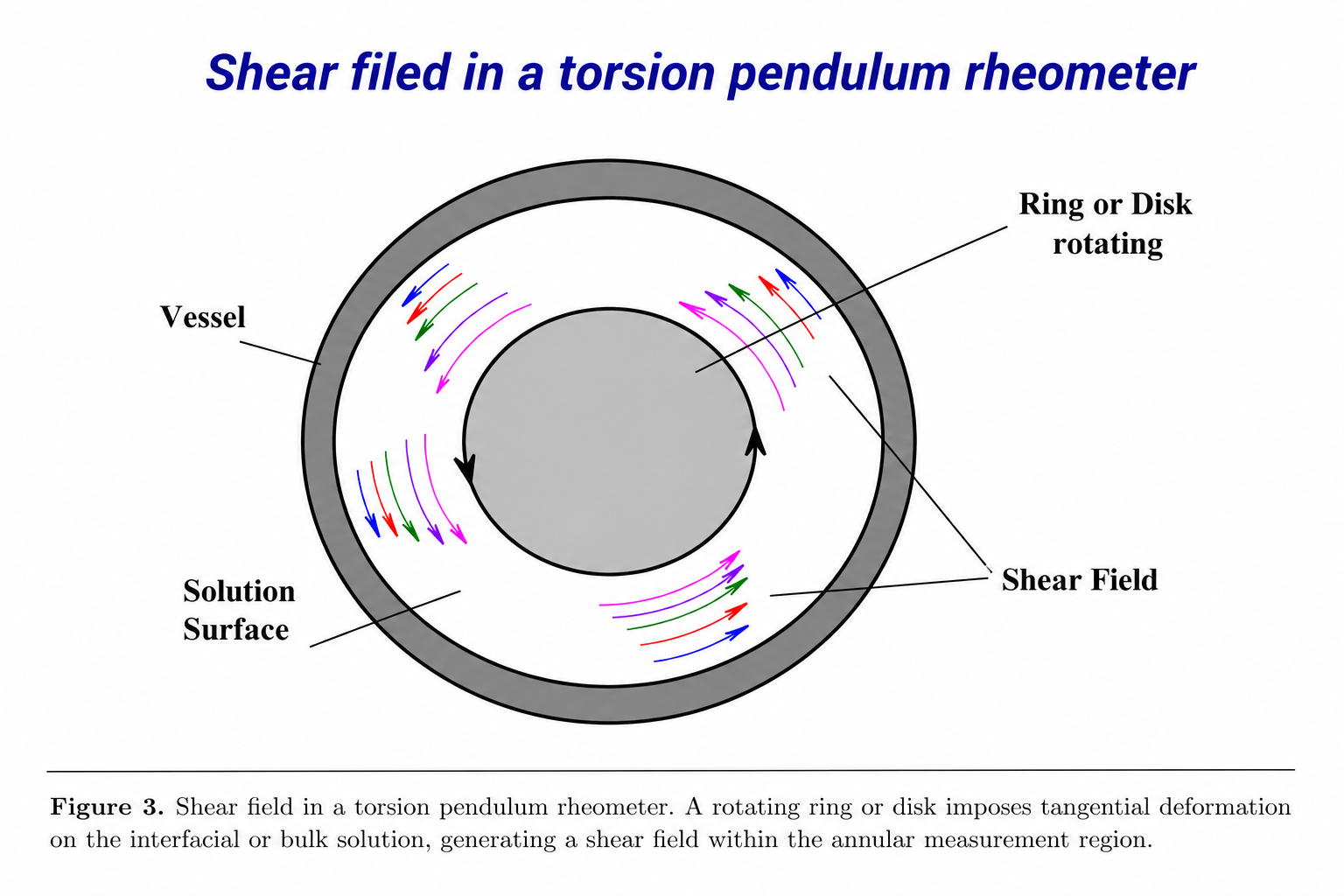
A torsion-pendulum rheometer uses a measuring body coupled to a torsion wire and positioned at the interface. A small angular displacement generates a tangential shear field. The restoring and dissipative torques produced by the interface modify the motion of the measuring body. [P1, 10, 11]
The method must separate interfacial torque from bulk viscous drag. This requires an accurate hydrodynamic model and calibration of the mechanical system. Because interfacial stresses can be extremely small, low-friction suspension and sensitive angular detection are essential. [P1]
13.2 Automated torsion rheometers
The source material cites the automated apparatus described by Krägel, Siegel, Miller, Born and Schano in 1994. The development of automated torsion rheometry made it possible to measure small-amplitude interfacial shear elasticity and viscosity reproducibly over long adsorption times. [P1, 10, 11, 1]
13.3 Fourier analysis
For oscillatory torsion measurements, Fourier analysis separates the fundamental response from noise and higher harmonics. Miller lecture describes the ISR-1 as obtaining results through Fourier analysis. This is particularly useful when the angular deflections are intentionally kept very small. [P1, 9, 13, 10]
14 · Scientific Review
Dedicated 2D rheometers versus 3D rheometers used at interfaces
Conventional rotational rheometers can be adapted to interfacial measurements using geometries such as biconical disks, rings or double-wall rings. These instruments benefit from mature torque control and broad frequency ranges. However, the measured torque includes bulk contributions and can be challenging to interpret when interfacial stresses are very small. [P1, 4, 5]
Dedicated two-dimensional instruments are optimized for interfacial sensitivity. The source material compares the ISR1 with an Anton Paar MCR301 for poly(methyl methacrylate) Langmuir films, referring to the study by Maestro, Ortega, Monroy, Krägel and Miller. Such comparisons are valuable because they test whether different instrument geometries recover consistent interfacial properties. [P1]
No geometry is universally superior. Strong interfacial films can be measured with conventional rheometers, whereas very weak adsorption layers may require a highly sensitive torsion-wire method. Method selection should therefore follow the expected modulus and bulk viscosity. [P1, 10, 11, 1]
15 · Scientific Review
Linear versus nonlinear interfacial rheology
15.1 Linear regime
The complex-modulus formalism assumes that the response is linear: stress is proportional to strain amplitude and the waveform remains essentially sinusoidal. This regime must be established experimentally by amplitude sweeps or equivalent tests. If the measured modulus depends strongly on amplitude, the interface is outside the linear region. [P1]
15.2 Structural rupture
Fragile interfacial layers can yield or fracture under excessive deformation. This is especially relevant for protein films, particle layers and condensed monolayers. A large measured loss signal can therefore reflect irreversible structural damage rather than linear viscous dissipation. [P1, 1, 14]
15.3 Higher harmonics
Nonlinear deformation generates higher harmonics in the stress response. Fourier analysis can reveal these contributions. While higher harmonics are undesirable when the goal is a linear modulus, they can provide useful information about yielding, strain stiffening and structural rearrangement in deliberately nonlinear experiments. [P1, 9, 13]
16 · Scientific Review
Interfacial rheology, Marangoni stresses and film stability
A local variation in surface concentration creates a variation in surface tension. The resulting tangential stress drives Marangoni flow from regions of low tension toward regions of high tension. A surface-active adsorption layer can therefore oppose local deformation by generating restoring tension gradients. [P1, 1, 14]
This mechanism provides a direct connection between dilational elasticity and the stability of foams and emulsions. When a thin film is stretched locally, the surface concentration decreases and the tension rises. A sufficiently elastic adsorption layer generates a restoring flow that can redistribute liquid and surfactant toward the disturbed region. [P1, 1, 2, 4]
The relationship is not one-to-one. Film stability also depends on drainage, disjoining pressure, bulk viscosity and interfacial shear properties. Nevertheless, interfacial rheology provides information that equilibrium tension alone cannot supply because it measures the mechanical resistance of the adsorption layer to the deformations occurring during film thinning and droplet collisions. [P1, 10, 11, 1]
17 · Scientific Review
Applications
17.1 Foams
Foam interfaces undergo continuous expansion, compression and shear during bubble generation, drainage and rearrangement. A layer with high dilational elasticity can resist local area changes and support Marangoni stabilization. Shear elasticity can indicate network formation in protein, polymer or particle-stabilized foams. [P1, 10, 11, 1]
17.2 Emulsions
Oil-water interfaces deform during droplet breakup, collision and coalescence. Dilational rheology probes how quickly an emulsifier layer restores stress after area change, while shear rheology probes the lateral integrity of the film. These properties are particularly important for protein-stabilized and particle-stabilized emulsions. [P1, 10, 11, 1]
17.3 Proteins
Proteins form adsorption layers whose rheology evolves with time as molecules unfold and form intermolecular contacts. The resulting films can become highly elastic and even weakly solid-like. Interfacial rheology is therefore a sensitive method for distinguishing adsorption from subsequent network formation. [P1, 1, 2, 4]
17.4 Lipids and biological monolayers
Lipid monolayers such as DPPC can undergo condensed and expanded states with markedly different mechanical properties. The source material includes DPPC as an example in the shear-rheology section. Such systems are relevant to pulmonary surfactant and membrane-related interfacial physics. [P1, 10, 11, 1]
17.5 Polymer and Langmuir films
Polymer monolayers can produce pronounced interfacial shear response. The comparison of PMMA Langmuir films measured with dedicated and conventional shear rheometers illustrates how mechanically coherent two-dimensional layers can be characterized quantitatively. [P1, 10, 11, 1]
17.6 Particles at interfaces
Particle-laden interfaces can develop jammed or percolated structures with large shear elasticity and nonlinear yielding. Although detailed particle rheology is beyond the main scope of the source lecture, the same shear and dilational concepts apply and help explain the robustness of Pickering emulsions. [P1, 10, 11, 1]
17.7 Coatings, food and pharmaceutical formulations
Interfacial layers in coatings, food emulsions and pharmaceutical formulations are repeatedly deformed during processing. Frequency-dependent rheological measurements can therefore be matched to process timescales, distinguishing layers that respond elastically during rapid deformation from those that relax quickly through molecular exchange. [P1, 4, 5, 1]
18 · Scientific Review
Experimental design and quality control
18.1 Define the interfacial state
The composition and age of the interface must be controlled before rheology begins. For soluble species, bulk concentration, temperature, phase volumes and equilibration time determine the adsorption layer. For proteins and polymers, waiting time can alter the modulus even when surface tension changes only slowly. [P1, 1, 2, 4]
18.2 Establish the linear amplitude range
A small-amplitude oscillation should be verified to produce an amplitude-independent modulus. If the layer is damaged or restructured by the oscillation, the resulting value no longer represents linear viscoelasticity. [P1, 1, 2, 4]
18.3 Report frequency explicitly
Because all rheological parameters depend on frequency, a modulus without frequency is incomplete. A full frequency sweep is preferable when the objective is mechanistic understanding. If only one frequency is used, it should be selected to match the relevant physical process and clearly reported. [P1, 4, 5, 1]
18.4 Correct bulk hydrodynamics
Both dilational and shear instruments couple to the adjoining liquids. Bulk viscosity can dominate the measured force or pressure if the interfacial response is weak. Analysis must therefore include the hydrodynamic contribution appropriate to the measurement geometry. [P1, 10, 11, 1]
18.5 Control temperature
Temperature affects surface tension, adsorption equilibrium, diffusion, bulk viscosity and interfacial structure. ipid and protein layers can undergo particularly strong structural changes with temperature. Accurate thermal control is therefore part of the rheological measurement. [P1, 4, 5, 1]
18.6 Avoid evaporation and contamination
Long interfacial measurements are sensitive to evaporation and trace impurities. Evaporation changes concentration and area; contamination creates additional adsorption layers. Closed cells and validated cleaning procedures are especially important for low-frequency measurements lasting many minutes or hours. [P1, 4, 5, 1]
19 · Scientific Review
Choosing a dilational-rheology method
The source lecture presents methods across several frequency decades. Oscillating barriers and profile-based drop or bubble oscillations cover approximately 0.001 to 0.1 Hz. Longitudinal waves cover an intermediate range around 0.1 to 15 Hz. Oscillating drops using capillary-pressure detection can extend to roughly 100 Hz, while oscillating-bubble and capillary-wave techniques can reach several hundred hertz. [P1, 4, 5, 6]
Method selection should be based on the relaxation times of the system. A slowly aging protein film may require millihertz measurements and long equilibration. A low-molecular-weight surfactant may require tens or hundreds of hertz to approach the high-frequency modulus. A liquid-liquid system with nearly matched density is better suited to capillary-pressure detection than to gravitational profile analysis. [P1, 4, 5, 1]
Complementarity. A broad interfacial relaxation spectrum is best measured by overlapping methods. The goal is not to force one technique across every frequency decade, but to verify that different methods describe a consistent physical response in their common range. [P1, 4, 5]
20 · Scientific Review
Choosing a shear-rheology method
For weak adsorption layers, dedicated torsion-wire or torsion-pendulum instruments provide high sensitivity at small deflection. For stronger films, conventional rotational rheometers equipped with interfacial geometries can offer broader strain and frequency control. The expected shear modulus, bulk viscosity, interface accessibility and risk of structural damage determine the appropriate instrument. [P1, 4, 5, 10]
The source lecture emphasizes small deflections for the ISR-1 specifically to avoid breaking structures. This principle is general: the method should perturb the interface enough to generate a measurable signal but not enough to change the structure being characterized. [P1]
21 · Scientific Review
Instrument platforms
21.1 Profile Analysis Tensiometry for slow dilational rheology
Profile analysis tensiometers can impose controlled volume oscillations while simultaneously determining area and surface tension from the drop contour. This provides a direct route to low-frequency dilational elasticity and viscosity for liquid-gas and liquid-liquid interfaces. [P1, 4, 5, 1]
21.2 High-frequency oscillating drop/bubble modules
The source material describes a piezo-driven oscillating drop/bubble analyser used with a profile-analysis platform. At higher frequency, capillary pressure rather than full contour deformation is used to monitor rapid tension changes. The concept extends the accessible frequency range by approximately three orders of magnitude relative to slow dosing oscillations. [P1, 4, 5, 2]
21.3 Surface Shear Rheometer ISR-1
Miller lecture identifies the SINTERFACE ISR-1 as a sensitive surface and interfacial shear rheometer. Its key methodological characteristics are small deflections, preservation of fragile structures and Fourier-based signal analysis. It is therefore intended for adsorption layers whose shear response would be difficult to resolve with conventional bulk-rheometer geometries. [P1, 10, 11, 1]
22 · Scientific Review
Limits of interpretation
Interfacial rheological quantities are model-dependent observables. The measured force, pressure or motion is converted into a two-dimensional modulus using assumptions about geometry and bulk hydrodynamics. Apparent discrepancies between methods can therefore originate from analysis models rather than from the interface itself. [P1, 1, 2, 4]
The source lecture provides an instructive warning in its discussion of oscillating-bubble experiments under terrestrial and microgravity conditions: the experimental results were not yet quantitatively understood theoretically. Such examples are valuable because they show that sophisticated measurements should not be over-interpreted simply because the instrumental precision is high. [P1]
Likewise, a complex modulus cannot uniquely identify molecular structure. A high E′ can arise from dense surfactant packing, a protein network, a condensed lipid state or a particle network. Complementary tensiometry, microscopy, ellipsometry or structural techniques are required for molecular interpretation. [P1, 1, 14]
23 · Scientific Review
Conclusions
Interfacial rheology provides a quantitative description of how adsorption layers resist deformation. Dilational rheology probes expansion and compression and is strongly coupled to adsorption, desorption diffusion. Shear rheology probes lateral deformation at nearly constant area and is particularly sensitive to network formation and interfacial connectivity. [P1, 4, 5, 10]
The complex dilational modulus separates the response into storage and loss components. Its frequency dependence reflects the competition between imposed deformation and the relaxation processes available the interfacial layer. The Lucassen-van den Tempel framework explains why the elastic response of a soluble surfactant layer rises toward a limiting high-frequency modulus while the effective dilational viscosity can pass through a maximum. [P1, 4, 5, 1]
No single experimental technique spans the complete frequency range. Slow oscillating-drop profile analysis, oscillating barriers, wave methods, capillary-pressure oscillations and oscillating bubbles provide complementary access from millihertz to hundreds of hertz. Transient relaxation experiments provide an alternative time-domain description. For shear rheology, torsion-pendulum instruments and adapted rotational rheometers probe the lateral mechanical strength of adsorption layers. [P1, 4, 5, 8]
Reliable measurements require control of the interfacial state, deformation amplitude, frequency, temperature, bulk hydrodynamics and interfacial age. A modulus reported without these conditions is incomplete. This requirement is especially important for soluble surfactants and proteins, where molecular exchange and structural aging can change the response continuously. [P1, 4, 5, 1]
The scientific value of interfacial rheology lies in its ability to distinguish interfaces that may appear similar by equilibrium tension but behave very differently under deformation. For foams, emulsions, proteins, lipids, polymers and particle-stabilized systems, this mechanical information provides a direct connection between molecular organization at the interface and macroscopic stability. [P1, 1, 2, 4]
Source basis
Source basis
Primary sources
P1. Dilational and Shear Rheology of Interfacial Layers, by SINTERFACE Technologies.
P2. Dynamic surface and interfacial tension methods, by SINTERFACE Technologies.
P3. Profile Analysis Tensiometry (PAT) and Maximum Bubble Pressure (BPT): Fundamentals and Applications, by SINTERFACE Technologies.
P4. Experimental methods to measure the adsorption at liquid interfaces, by SINTERFACE Technologies.
References
References
1. R. Miller and L. Liggieri (Eds.), Interfacial Rheology, Progress in Colloid and Interface Science, Vol. 1, Taylor & Francis, 2009.
2. R. Miller and L. Liggieri (Eds.), Bubble and Drop Interfaces, Progress in Colloid and Interface Science, Vol. 2, 2011.
3. D. Möbius and R. Miller (Eds.), Drops and Bubbles in Interfacial Research, Studies in Interface Science, Vol. 6, Elsevier, Amsterdam, 1998.
4. J. Lucassen and M. van den Tempel, Dynamic measurements of dilational properties of a liquid interface, Chemical Engineering Science 27 (1972) 1283-1291.
5. J. Lucassen and M. van den Tempel, Longitudinal waves on visco-elastic surfaces, Journal of Colloid and Interface Science 41 (1972) 491-498.
6. V. G. Levich, The damping of waves by surface-active substances, Acta Physicochimica URSS, 1941.
7. A. Passerone, L. Liggieri, N. Rando, F. Ravera and E. Ricci, Journal of Colloid and Interface Science 146 (1991) 152.
8. R. Miller, R. Sedev, K.-H. Schano, C. Ng and A. W. Neumann, work on drop-relaxation methods for transient interfacial dilational rheology, 1993.
9. E. Benjamins, A. Cagna and E. H. Lucassen-Reynders, harmonic oscillations of drops and bubbles for interfacial dilational rheology, 1996.
10. J. Krägel, S. Siegel, R. Miller, M. Born and K.-H. Schano, Measurement of Interfacial Shear Rheological Properties: An Automated Apparatus, Colloids and Surfaces A 91 (1994) 169-180.
11. A. Maestro, F. Ortega, F. Monroy, J. Krägel and R. Miller, Surface shear rheological properties of poly(methyl methacrylate) Langmuir films: comparison between two different surface shear rheometers, Langmuir 25 (2009) 7393.
12. B. A. Noskov and co-workers, developments in capillary- and longitudinal-wave methods for interfacial dilational rheology, as summarized in the Miller lecture material.
13. Kretzschmar and Lunkenheimer, early oscillating-bubble technique for interfacial dilational rheology, 1970; Lunkenheimer thesis, Berlin, 1971.
14. B. Aveyard, Surfactants: In Solution, at Interfaces and in Colloidal Dispersions, Oxford University Press, 2019.