
00 · Abstract
Abstract
Thin liquid films are free-standing or confined liquid layers whose thickness becomes small enough for the two bounding interfaces to interact. They are fundamental structural elements of foams and emulsions, yet they also provide a uniquely sensitive experimental system for studying intermolecular surface forces. The transition from an ordinary liquid layer to a thin film changes the physics qualitatively: capillary pressure drives drainage, hydrodynamic resistance slows thinning, and surface forces generate a disjoining pressure that can stabilize discrete equilibrium thicknesses or promote collapse. [P1, P3, 8, 1, 2]
The primary source framework of this review is Miller's lecture on Thin Liquid Films, supplemented by his Foam Films and Foams lecture and the historical presentation Chronicles of Foam Films. These sources organize the subject around free liquid films, DLVO theory, the classification of foam-film states, optical thickness measurements and experimental model systems. The scientific treatment is complemented by the standard monographs Foam and Foam Films by Exerowa and Kruglyakov and Foam Films and Foams: Fundamentals and Applications edited by Exerowa, Gochev, Platikanov, Liggieri and Miller. [P1, P3, 6, 7, 8]
A central concept is the disjoining pressure Π(h), which describes the interaction between two interfaces separated by a film of thickness h. In an equilibrium free film, disjoining pressure balances the capillary pressure imposed by the film holder or surrounding meniscus. The classical DLVO contribution contains attractive van der Waals forces and repulsive electrostatic double-layer forces. Depending on electrolyte concentration, surface charge and pressure, the film may remain as a relatively thick common thin film, jump to a common black film or reach a still thinner Newton black film. [P1, P3, 6, 7, 1]
Optical interference provides a direct experimental window into film thickness. The colored interference patterns of soap films were already central to the work of Hooke and Newton, while nineteenth- and twentieth-century measurements linked color, electrical resistance and molecular-scale thickness. Modern instruments use controlled illumination, microscopy and quantitative reflectance or interferometry to follow film thinning continuously. [P1, P3, 1, 2, 8]
Model-film experiments isolate the mechanisms that are hidden inside macroscopic foams. The film-pressure balance, ring-cell thin-film analyzers and micro-manipulation methods permit control of capillary pressure, film radius and interfacial composition while recording drainage, dimple formation, black-spot nucleation and rupture. The Drop-Bubble Micro Manipulator developed Makievski and Miller extends this philosophy to the interaction of two independently controlled drops or bubbles. [P2, P1, 3, 1, 2]
The principal conclusion is that thin-film stability cannot be inferred from surface tension alone. Surface tension and film tension are distinct, and equilibrium film thickness is governed by the full interaction-pressure isotherm together with capillary pressure and interfacial mobility. Thin-film analysis therefore provides the mechanistic bridge between molecular adsorption layers and the lifetime of foams and emulsions. [P1, P3, 4, 8, 1]
Keywords
Keywords
thin liquid films; foam films; disjoining pressure; DLVO theory; film drainage; common thin film; common black film; Newton black film; film pressure balance; interferometry; film thickness; rupture; capillary pressure; DBMM; TFA
01 · Scientific Review
What is a thin liquid film?
A free liquid film consists of a liquid layer bounded by two fluid interfaces. In a foam film, both outer phases are gas. In an emulsion film, the external phases can be liquid. The film can be connected to a surrounding meniscus or Plateau border that acts as a liquid reservoir and imposes capillary pressure. [P1, P2, 1, 2]
At large thickness, the two interfaces behave almost independently. As thickness decreases, their diffuse double layers, van der Waals fields, hydration structures or adsorbed macromolecular layers begin to overlap. The film then acquires properties that cannot be represented by two isolated surfaces. [P1, P3, 6, 7, 8]
Key distinction. A thin film is not simply two surfaces placed next to each other. Once the interfaces interact, film free energy, film tension and equilibrium thickness become collective properties of the two-interface system. [P1, P3, 4, 8, 1]
02 · Scientific Review
Historical development
2.1 Optical colors
Soap-film colors provided one of the earliest experimental observations of nanoscale thickness long before molecular-scale instrumentation existed. Hooke and Newton recognized that transparent films acquire colors when their thickness becomes comparable to visible wavelengths. Newton's color bands established a systematic relation between optical appearance and thickness. [P1, P3, 8]
The historical material used by Miller and co-workers traces this development through Brewster, Fusinieri, Reinold and Rücker and later black-film studies. The fact that a film can appear optically black does not mean that its thickness is zero; it means that the reflected intensity has become very small because the film is much thinner than wavelengths and the optical phase relation suppresses reflection. [P1, P3, 8]
2.2 Black films
Nineteenth-century measurements of black soap films combined optical observation with electrical resistance and surface-tension studies. These experiments established that films could reach limiting thicknesses far below one micrometer and remain stable. [P1, P3, 1, 2, 8]
Later work distinguished common black films from Newton black films. The historical lecture notes Newton black-film thicknesses of only several nanometers in sodium oleate systems, substantially thinner than common black films. [P1, P3, 1, 2, 8]
2.3 From phenomenology to interaction forces
The development of DLVO theory transformed black films from optical curiosities into quantitative probes of surface forces. Derjaguin and Landau and, independently, Verwey and Overbeek described the competition between attractive van der Waals interaction and repulsive electrostatic double-layer interaction. Mysels and Scheludko later developed pressure-balance experiments that directly related film thickness to disjoining pressure. [P1, P3, 6, 7, 1]
03 · Scientific Review
Film geometry and capillary pressure
A free film is typically connected to a curved meniscus. The curvature of that meniscus creates a pressure difference between the liquid inside the film and the surrounding phase. This capillary pressure is the principal mechanical driving force for drainage. [P1, P2, 1, 2]
Young-Laplace pressure
The film itself may be nearly planar while the surrounding meniscus is strongly curved. Liquid therefore drains from the high-pressure film region toward the Plateau border or reservoir until viscous resistance and surface forces arrest the thinning or until rupture occurs. [P1, P2, 1, 2]
04 · Scientific Review
Hydrodynamics of film drainage
4.1 Squeezing flow
When two interfaces approach, liquid must flow radially outward. For a film much thinner than its lateral radius, lubrication theory provides the natural hydrodynamic approximation. The drainage rate decreases strongly as thickness decreases because viscous resistance rises rapidly in the narrow gap. [P1, P3, 8, 1, 2]
This explains why a film can spend a large fraction of its lifetime in the final stages of thinning even though the initial approach is rapid. Small changes in interfacial mobility or viscosity can therefore alter lifetime strongly. [P1]
4.2 Dimple formation
Drainage is often nonuniform. The center of a newly formed film can remain thicker than the periphery, creating a dimple. Miller foam lecture includes the appearance of a dimple as an early step in the film-formation sequence between approaching droplets or bubbles. [P2, P1, 3, 1, 2]
The dimple subsequently flattens or reorganizes as liquid drains. The details depend on film radius, approach velocity, interfacial mobility, capillary pressure and surface forces. [P2, P1, 3, 1, 2]
4.3 Mobile and immobile interfaces
If surfactant can redistribute freely, tangential flow at the interface reduces viscous resistance and accelerates drainage. If surface concentration gradients generate strong Marangoni stresses or the adsorption layer has high surface viscosity, the interfaces behave more nearly immobile and drainage slows. [P1, P5, 9, 1, 2]
This coupling explains why film drainage cannot be predicted from bulk viscosity alone. Interfacial rheology enters directly through the hydrodynamic boundary condition. [P1, P5, 9, 1, 2]
05 · Scientific Review
Disjoining pressure
5.1 Definition
Disjoining pressure Π(h) expresses the normal interaction between two interfaces separated by a film of thickness h. It can be defined thermodynamically as the derivative of the interaction free energy per unit area with respect to film thickness or mechanically as the excess pressure required to maintain a film at a specified thickness. [P1, P3, 8, 1, 2]
Thermodynamic definition
5.2 Equilibrium condition
In the classical film-pressure-balance geometry, equilibrium thickness is obtained when the disjoining pressure equals the externally imposed capillary pressure. [P1, P3, 8, 1, 2]
Equilibrium pressure balance
The complete Π(h) curve is therefore more informative than a single film-thickness value. It describes the sequence of stable and unstable thicknesses available as the external pressure is changed. [P1, P3, 8]
06 · Scientific Review
DLVO theory for liquid films
6.1 van der Waals attraction
London dispersion interactions across the film generate an attractive van der Waals contribution. In the simplest nonretarded symmetric-film approximation, the disjoining-pressure contribution scales inversely with the cube of thickness. [P1, P3, 6, 7, 8]
van der Waals contribution
The Hamaker constant A_H summarizes the dielectric properties of the three media. Its sign and magnitude depend on the material combination and can differ substantially between air-water-air and oil-water-oil films. [P1]
6.2 Electrostatic double-layer repulsion
Charged adsorption layers create diffuse ionic atmospheres. When two charged interfaces approach, the diffuse layers overlap and generate an electrostatic interaction. The range is controlled by the Debye screening length, which decreases as electrolyte concentration increases. [P1, 6, 7]
High surface charge and low electrolyte concentration therefore favor a substantial repulsive barrier, whereas strong screening can remove the barrier and permit rapid collapse toward the primary attractive minimum. Miller's lecture presents this contrast explicitly as a stable high-charge/low-electrolyte system versus fast coagulation when no electrostatic barrier remains. [P1, 6, 7]
6.3 Combined interaction
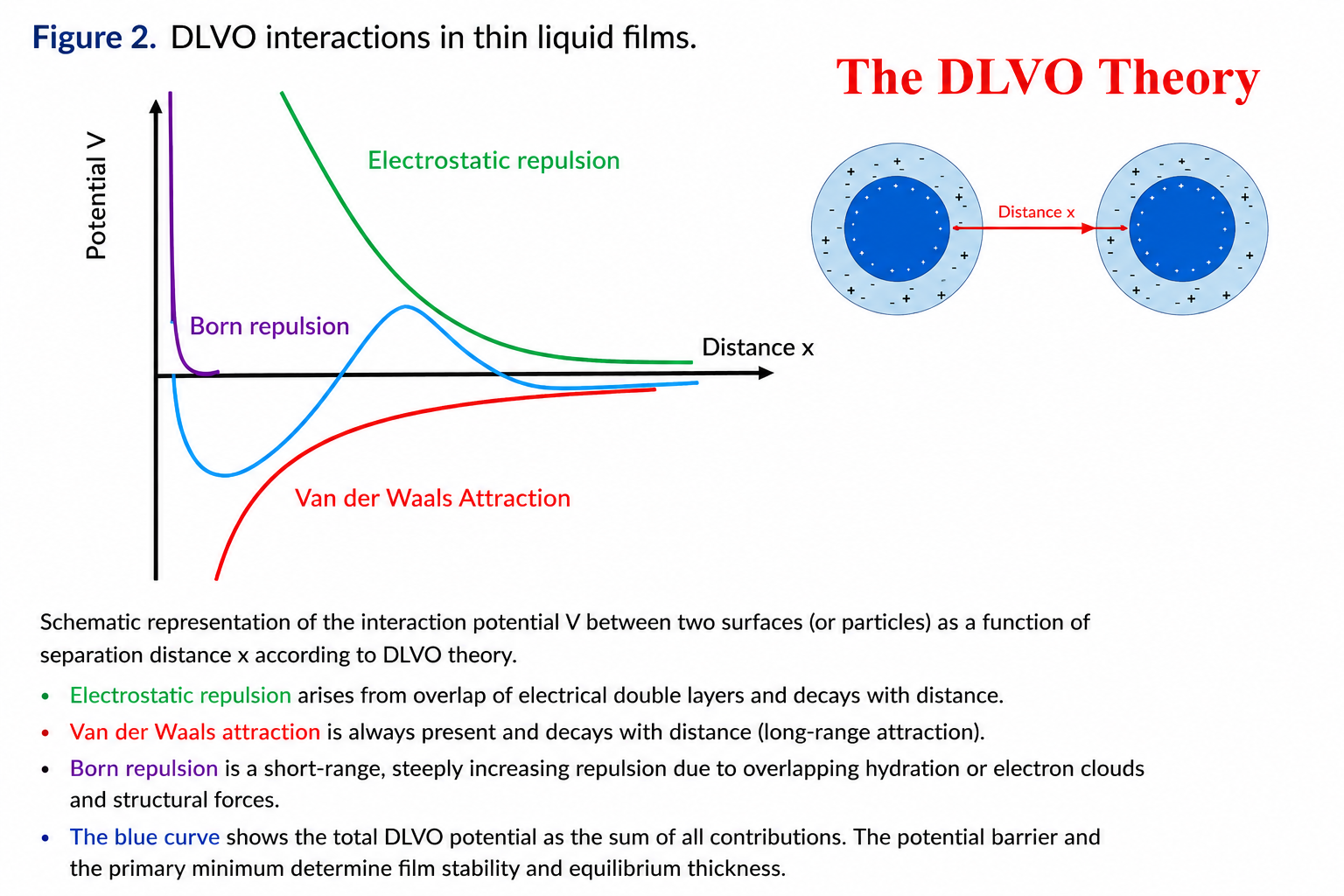
Classical DLVO pressure
A secondary minimum can correspond to weakly bound or metastable states, while a primary minimum represents close approach under strong attraction. In free liquid films, the detailed mapping between interaction potential and film state is modified by capillary pressure and short-range forces, but the same physical competition remains central. [P1, 1, 2]
07 · Scientific Review
Non-DLVO forces
At very small separation, additional interactions can become decisive. Hydration forces arise from structured water and strongly hydrated head groups. Steric forces arise when polymeric or macromolecular adsorption layers overlap. Structural forces can appear in concentrated surfactant systems, while membrane-like lipid or protein layers can introduce bending and conformational contributions. [P1]
The existence of Newton black films at only a few nanometers thickness demonstrates that short-range interactions cannot always be ignored. A film can remain stable even in a regime where the diffuse double layer is strongly compressed. [P1, P3, 6, 7, 1]
08 · Scientific Review
Types of foam films
8.1 Common thin film
The common thin film is the relatively thick state from which further drainage or transition to a black film can occur. Its optical interference colors can remain visible, and the two interfaces interact less strongly than in black-film states. [P1, P3, 1, 2, 8]
8.2 Common black film
A common black film is thinner and optically dark. Its stability is commonly associated with a balance between capillary pressure and electrostatic or other longer-range repulsion. Its thickness remains larger than that of a Newton black film. [P1, P3, 6, 7, 1]
8.3 Newton black film
The Newton black film is an ultrathin state, often only several nanometers thick. The two adsorption layers and confined liquid are strongly coupled. Short-range forces and molecular structure become dominant, and the classical picture of two independent surfaces is no longer adequate. [P1, P3, 1, 2, 8]
8.4 Transitions between states
The transition from common thin to black film often proceeds through localized black spots that nucleate and grow. Miller's foam lecture explicitly lists destabilization at a critical thickness, black-spot formation and growth, black-film formation and thinning of thick films as characteristic stages. [P1, P3, 1, 2, 8]
09 · Scientific Review
Film tension and surface tension
Surface tension is the free-energy cost per unit area of one isolated interface. Film tension is the mechanical tension associated with the entire two-interface film. Once the interfaces interact, the film free energy contains an interaction term and cannot be described simply as twice the single-interface free energy. [P1, 4]
Kim, Koszo and Wasan analyzed dynamic film and interfacial tensions in foam and emulsion systems, and Miller's lecture uses their work specifically to emphasize the difference between a single adsorption layer and a foam film. [P1, P2, 4, 1, 2]
This distinction is important for interpreting film mechanics. A change in film thickness can alter interaction free energy without an equivalent change in the surface tension of either isolated adsorption layer. [P1, P3, 8, 1, 2]
10 · Scientific Review
Optical thickness measurement
10.1 Interference
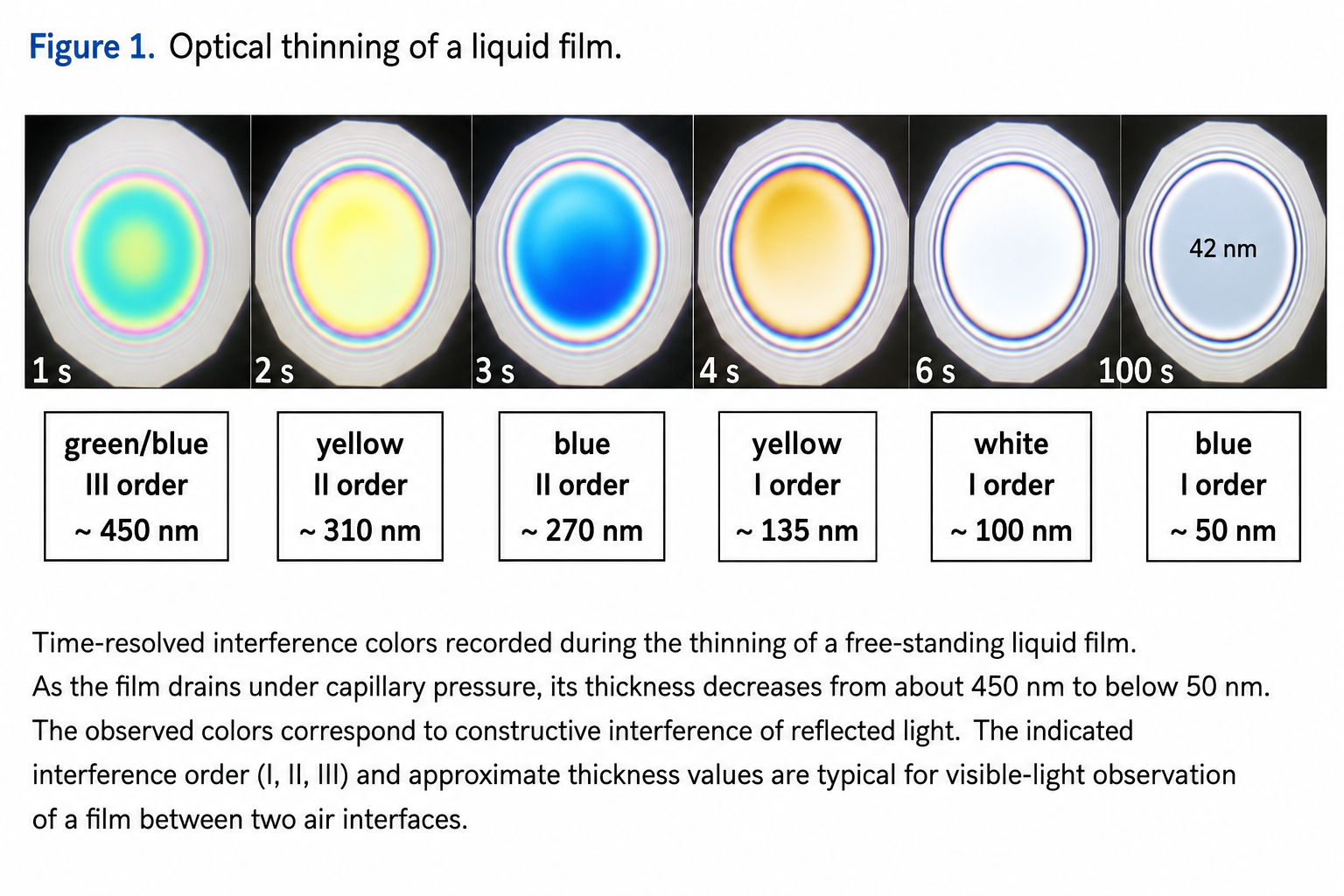
Light reflected from the two surfaces of a thin film interferes. The reflected intensity depends on wavelength, refractive indices, incidence angle and film thickness. Under white light, this produces the familiar color sequence of soap films. Under monochromatic illumination, intensity can be converted quantitatively into thickness when the optical model is known. [P1, P3, 1, 2, 8]
10.2 Black-film regime
As the thickness becomes very small, the reflected intensity decreases and the film appears black. Quantitative instruments must distinguish true thickness changes from variations in illumination, refractive index or surface contamination. [P1, P3, 8]
10.3 Refractive-index assumptions
The conversion from intensity to thickness commonly assumes a refractive index for the film liquid. If adsorption layers or concentrated solute regions contribute significantly to optical path length, the apparent thickness may differ from the hydrodynamic thickness. This is particularly relevant for protein and polymer films. [P1, P3, 8]
11 · Scientific Review
Film Pressure Balance
11.1 Principle
The film pressure balance is the classical method for measuring equilibrium film thickness as a function of pressure. A planar film is formed in a small aperture or holder and connected to a liquid reservoir. The gas pressure or capillary pressure is varied while optical thickness is recorded. [P1, P3, 8, 1, 2]
Each pressure produces an equilibrium thickness if the film remains stable. The resulting Π(h) isotherm provides direct experimental information about the interaction forces across the film. [P1, P3, 8, 1, 2]
11.2 Stable and unstable branches
A film can jump discontinuously between thickness states when a metastable branch disappears. Such transitions are the experimental expression of multiple minima or barriers in the film free-energy landscape. Pressure-balance measurements therefore reveal more than a simple thinning curve. [P1, P3, 8]
12 · Scientific Review
Foam Film Tensiometry
Foam-film tensiometry was developed to characterize the mechanical tension of an entire thin film rather than only the tension of a single interface. Miller lecture introduces the method through the work of Kim, Koszo and Wasan and uses it to establish the distinction between film and surface tension. [P1, P2, 1, 2]
The technique is especially relevant when interaction between the two surfaces is strong. It complements pressure-balance measurements by probing a different derivative of the film free energy. [P1]
13 · Scientific Review
Ring-cell thin-film analyzers
13.1 Controlled film formation
Miller's foam lecture describes a thin-film analyzer that creates foam films in a ring cell, provides film thickness and permits optical monitoring of thinning. The geometry allows repeated formation of a film under controlled liquid composition and environmental conditions. [P1, P3, 8, 1, 2]
13.2 Optical monitoring
An inverse or reflected-light microscope can record the transition from colored thick films through intermediate states to black films. Drainage channels, black spots and rupture events become directly visible. [P1, P3, 1, 2, 8]
13.3 Modern thin-film analysis
Modern instruments retain this core concept while improving camera sensitivity, pressure control, temperature control and automated thickness analysis. The scientific observable remains the same: film thickness and morphology as functions of time and imposed pressure. [P1, P3, 8]
14 · Scientific Review
Drop-Bubble Micro Manipulator
The DBMM developed by Won, Krägel, Makievski and co-workers provides a complementary way to generate a film between two independently controlled curved interfaces. Two bubbles, two drops or a drop and a bubble are positioned by fine dosing systems and piezo stages. [P2, 3]
The method is particularly useful for mimicking the transient film formed during a real collision rather than a static planar film. Approach velocity, waiting time, oscillatory perturbation and capillary pressure can be controlled, while coalescence is detected optically or by pressure change. [P1, P3, 8, 1, 2]
Because the film is created dynamically, the DBMM links thin-film science directly to emulsion and foam. [P2, 3]
15 · Scientific Review
Film formation sequence
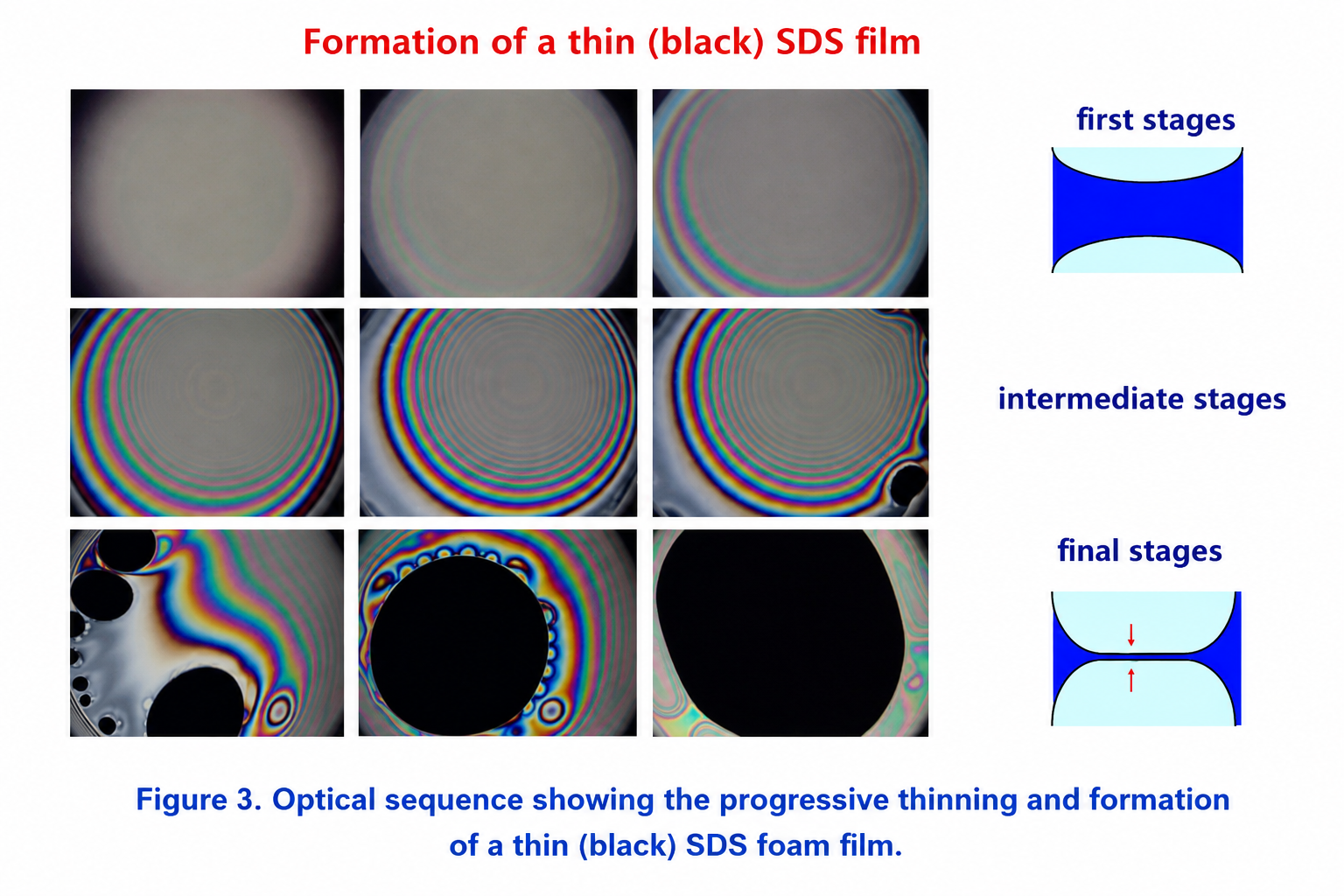
The film between approaching interfaces forms through a reproducible qualitative sequence. First, hydrodynamic resistance slows the final approach. A dimple forms as liquid is trapped in the center. The film then expands laterally and thins. Depending on the interaction forces, it can stabilize at a finite thickness, undergo a transition to a black film or rupture. [P1, P3, 1, 2, 8]
Localized black spots are important because they demonstrate that thinning not be spatially uniform. A thin phase can nucleate within a thicker film and spread as a two-dimensional domain. The moving boundary between film states reflects a balance of capillary, interfacial and hydrodynamic forces. [P1, P3, 8]
16 · Scientific Review
Surfactant films
SDS films in Miller's lecture provide a classical example of the formation of a thin black surfactant film. Ionic surfactant concentration and electrolyte determine both adsorption and electrostatic interaction across the film. Increasing electrolyte screens repulsion and can shift the equilibrium film thickness or reduce the barrier to collapse. [P1, P3, 6, 7, 8]
Dynamic adsorption also matters. A rapidly expanding film can temporarily dilute the surface layer, changing both surface mobility and disjoining pressure. Thin-film dynamics should therefore be interpreted together with the interfacial age and surfactant transport. [P1, P5, 9, 1, 2]
17 · Scientific Review
Protein films
Beta-lactoglobulin films are used in the lecture material as an example of macromolecular thin films. Protein adsorption layers differ qualitatively from simple surfactant monolayers because the molecules can unfold, form intermolecular networks and generate steric or structural forces across the film. [P1, P2, 1, 2]
Protein-film stability can therefore increase strongly with aging. Two films formed from the same bulk concentration but at different adsorption times can show different drainage and rupture behavior. [P1, P2, 1, 2]
18 · Scientific Review
Emulsion films
Thin-film concepts extend directly to emulsions. When two oil droplets approach in water, a water film forms between the droplets. When two water droplets approach in oil, an oil film forms. The relevant Hamaker constants, interfacial charges and adsorption layers differ from those of air-water-air foam films. [P1, P2, 1, 2]
Khristov, Taylor, Czarnecki and Masliyah applied thin-film thickness measurements to water-oil-water bitumen-emulsion films. The example highlights why liquid-liquid films require careful optical and materials-specific analysis. [P1, P3, 5, 8]
19 · Scientific Review
Critical thickness and rupture
19.1 Deterministic instability
A thinning film can become unstable when the restoring pressure gradient is unable to suppress thickness fluctuations. The corresponding critical thickness depends on disjoining-pressure slope, capillary pressure, film radius and hydrodynamics. [P1, P3, 8, 1, 2]
19.2 Stochastic rupture
Real rupture can also be nucleated by dust, aggregates, local adsorption defects or thermal fluctuations. Film lifetime is therefore often statistical even under nominally identical conditions. [P1, P2, 1, 2]
19.3 Black-spot nucleation
In systems supporting black films, local transition to the thinner state can precede rupture. Whether a black spot grows into a stable black film or becomes a rupture nucleus depends on the free-energy difference between the states and online tension around the domain boundary. [P1, P3, 1, 2, 8]
20 · Scientific Review
Relationship between film behavior and foam lifetime
Miller's lecture explicitly links thin liquid films with foam lifetime. This connection is mechanistic: a foam can persist only while the films separating neighboring bubbles remain stable. However, the lifetime of a macroscopic foam is not equal to the lifetime of one isolated film because drainage, bubble rearrangement, gas diffusion and statistical distributions create additional levels of complexity. [P1, P2, 1, 2]
Single-film experiments are therefore model experiments rather than complete foam simulators. Their power lies in isolating one essential step and allowing the underlying forces to be quantified. [P1]
21 · Scientific Review
Experimental artefacts
21.1 Contamination
Thin films have enormous area-to-volume ratio. Trace surface-active contaminants can therefore alter adsorption layers strongly. Cleanliness of cells, capillaries and solutions is a prerequisite for reproducible film thickness and lifetime. [P1, P3, 8, 1, 2]
21.2 Evaporation
Evaporation changes film composition and can create thermal or concentration gradients. Closed cells and humidity control are especially important for long-lived films. [P1]
21.3 Optical calibration
Thickness inferred from interference requires calibrated illumination, camera response and refractive indices. Saturated images or unknown background reflection can create systematic thickness errors. [P1, P3, 8]
21.4 Pressure calibration
In pressure-balance experiments, the imposed pressure must correspond to the actual capillary pressure acting on the film. Hydrostatic heads, gas pressure offsets and meniscus geometry should be included. [P1, 1, 2]
21.5 Film radius
Drainage and instability depend on film radius. Comparing lifetimes without reporting radius can therefore be misleading even if thickness and composition are identical. [P1, P3, 8, 1, 2]
22 · Scientific Review
Applications
22.1 Foam formulation
Thin-film analysis reveals whether a foaming agent stabilizes films through electrostatic repulsion, interfacial immobility, short-range forces or network formation. This can guide the design of food, detergent and process foams. [P1, 6, 7]
22.2 Emulsion stability
Coalescence of emulsion droplets requires drainage and rupture of the intervening liquid film. Model-film experiments therefore provide direct mechanistic information about emulsifier performance. [P1, P2, 1, 2]
22.3 Protein formulations
Biopharmaceutical and food proteins can form persistent interfacial films. Film aging, thickness and rupture studies help distinguish adsorption from subsequent network formation. [P1, P3, 8, 1, 2]
22.4 Mineral and petroleum systems
Oil-water films are central to bitumen processing, flotation and enhanced oil recovery. Their stability depends on surfactants, natural surface-active species, electrolyte and oil composition. [P1, 5]
23 · Scientific Review
Recommended reporting standard
Thin-film experiments should report film type, surrounding phases, complete formulation, temperature, pH, electrolyte and interfacial aging protocol. Film geometry should include film radius, holder or ring dimensions and meniscus configuration. [P1]
Pressure-balance data require the imposed pressure and its method of calculation. Thickness measurements require wavelength, optical geometry, refractive-index assumptions and calibration procedure. Film lifetime should be defined from a reproducible formation point to a defined rupture criterion. [P1, P3, 8, 1, 2]
If black-film states are assigned, the optical or thickness criterion distinguishing common black from Newton black film should be stated. If model interaction parameters such as Hamaker constants are fitted, the assumed DLVO and non-DLVO contributions should be specified. [P1, P3, 6, 7, 1]
24 · Scientific Review
Conclusions
Thin liquid films are the mechanistic bridge between adsorption layers and the stability of foams and emulsions. Their behavior is controlled by capillary pressure, hydrodynamic drainage and the interaction between two opposing interfaces. [P1, P2, 1, 2]
Disjoining pressure provides the central thermodynamic-mechanical description. DLVO theory explains the competition between van der Waals attraction and electrostatic repulsion, while short-range hydration, steric and structural forces become increasingly important in ultrathin films. [P1, P2, 6, 7, 1]
Common thin, common black and Newton black films represent distinct thickness regimes and interaction states. Optical interference makes these transitions directly observable, while pressure-balance methods convert film thickness into an interaction-pressure isotherm. [P1, P3, 1, 2, 8]
Modern experimental tools extend the classical planar film to dynamically interacting curved interfaces. Ring-cell thin-film analyzers follow film thickness and black-film formation optically, while the DBMM developed with Makievski and Miller mimics the approach and coalescence of actual bubbles and droplets. [P2, P1, 3, 8]
The most important conceptual distinction is that surface tension and film tension are not identical. A stable thin film is a collective two-interface system whose free energy contains interaction contributions. Understanding that distinction is essential for connecting molecular adsorption to macroscopic foam and emulsion stability. [P1, P2, 4, 1, 2]
25 · Scientific Review
Quantitative drainage theory
25.1 Lubrication approximation
When the film thickness h is much smaller than the lateral film radius, the velocity field can be approximated by lubrication theory. Pressure gradients drive a predominantly radial flow, while the small gap strongly suppresses transverse motion. The volumetric flux is proportional to the pressure gradient and to a high power of film thickness, which explains the dramatic slowing of drainage as the film becomes thin. [P1, P3, 8, 1, 2]
For ideally immobile interfaces the classical Reynolds-type scaling predicts that the thinning rate decreases strongly with h. Mobile interfaces drain more rapidly because tangential stress at the boundary is smaller. Real surfactant films frequently lie between these limiting cases because Marangoni stresses immobilize the surface only partially. [P1, P5, 9]
25.2 Film radius
Drainage time increases with film radius because liquid must travel farther before reaching the surrounding meniscus. A large planar film can therefore live much longer than a small film at the same thickness and pressure. Film radius must be treated as an experimental state variable rather than as an incidental geometric detail. [P1, P3, 8, 1, 2]
25.3 Capillary pressure
Increasing capillary pressure increases the mechanical driving force for thinning. Pressure-balance experiments exploit this fact deliberately by varying pressure and recording the resulting equilibrium thickness. In dynamic collision experiments, the effective capillary pressure changes with bubble or drop radius and can evolve during approach. [P1, P3, 8, 1, 2]
26 · Scientific Review
Stability criterion from the disjoining-pressure isotherm
The equality Π(h)=Pc identifies possible equilibrium thicknesses, but not every intersection is stable. Mechanical stability requires that a small decrease in thickness generate a restoring change in pressure rather than amplify the perturbation. The local slope of the disjoining-pressure isotherm is therefore central to stability. [P1, P3, 8, 1, 2]
When the imposed pressure exceeds the maximum repulsive barrier supported by the film, no mechanically stable branch remains and the film must thin toward a new state or rupture. This provides a physical interpretation of pressure-induced transitions from common films to black films and of the shortened lifetime observed under increased capillary stress. [P1, P3, 1, 2, 8]
26.1 Metastable branches
A common thin film can persist on a metastable branch even when a thinner black-film state has lower free energy. Nucleation of a black spot is then required for transition. The activation barrier explains why nominally identical films can exhibit different transition times and why defects or vibration can trigger sudden thinning. [P1, P2, 1, 2]
27 · Scientific Review
Optical interference in more detail
27.1 Phase difference
The two reflected waves from the front and rear film interfaces acquire a phase difference determined by the optical path through the film and by phase shifts upon reflection. Constructive or destructive interference therefore varies periodically with thickness. Under monochromatic illumination this relationship can be inverted to calculate h, while white-light illumination produces the characteristic sequence of colors catalogued historically by Newton. [P1, P3, 8]
Because the reflected intensity is periodic in optical thickness, an unambiguous thickness assignment over a broad range may require tracking the complete thinning trajectory or using multiple wavelengths. Modern digital analysis benefits from continuous video because neighboring frames constrain which interference order is physically possible. [P1, P3, 8]
27.2 Black-film thickness
In the black-film regime the reflected signal is weak and the sensitivity of simple color analysis decreases. High-dynamic-range cameras, calibrated background subtraction and known refractive indices become increasingly important. Electrical conductivity or complementary structural methods can provide additional information in specialized experiments. [P1, P3, 8]
28 · Scientific Review
Surface mobility and Marangoni stresses
Film drainage is coupled to surfactant transport along the interfaces. Radial flow can convect surfactant, generating surface-concentration gradients. Because surface tension depends on concentration, these gradients generate Marangoni stresses that oppose interfacial motion. The resulting effective immobilization can slow drainage substantially. [P1, P5, 9, 1, 2]
The strength of this mechanism depends on adsorption kinetics. If surfactant exchanges rapidly with the bulk, concentration gradients are relaxed and the interface remains relatively mobile. If exchange is slow or the adsorption layer has strong elasticity, gradients persist and the interface becomes less mobile. Thus dynamic adsorption and interfacial rheology enter directly into film hydrodynamics. [P1, P5, 9]
29 · Scientific Review
Film rupture as a fluctuation problem
A perfectly uniform film is an idealization. Thermal fluctuations, capillary waves and local thickness variations are always present. As the film becomes thinner, attractive interactions can amplify these fluctuations. A local depression can then grow until the two interfaces make molecular contact or until a hole nucleates. [P1, P3, 8]
The probability of rupture therefore depends on both deterministic stability and observation time. Near a critical state, two nominally identical films can have different lifetimes because rupture is activated by random fluctuations or rare defects. Reporting distributions of film lifetime is more informative than a single value when stochastic rupture dominates. [P1, P2, 1, 2]
29.1 Role of particles and contaminants
A hydrophobic particle, dust grain or surfactant aggregate can bridge the film and create a local rupture nucleus. Such contamination is especially important because film volumes are extremely small. Sample filtration and rigorous cleaning are therefore not optional procedural details in quantitative thin-film experiments. [P1, P2, 1, 2]
30 · Scientific Review
Interfacial composition inside a thin film
The composition of the adsorption layers can change during thinning. Compression of the interfaces raises surface concentration, while liquid drainage can change the concentration of solutes in the confined film. In ionic systems, ion partitioning and double-layer overlap modify the local electrostatic environment relative to the bulk solution. [P1, P2, 6, 7, 1]
For macromolecules, the two opposing adsorption layers can overlap before the hydrodynamic film thickness approaches molecular dimensions. Steric interaction then contributes to disjoining pressure. Proteins can also form bridges or networks, producing behavior that differs fundamentally from a simple surfactant monolayer. [P1, P3, 4, 8, 1]
31 · Scientific Review
Model systems versus real foams and emulsions
Planar free films provide excellent access to interaction forces because geometry and pressure are controlled. Real foam films, however, are embedded in a deforming network and exchange liquid with Plateau borders. Real emulsion films form dynamically during droplet collisions and can have strongly curved interfaces. No single geometry reproduces every aspect of the practical system. [P1, P2, 1, 2]
The scientific strategy adopted in Miller lectures is therefore complementary: planar film tools quantify thickness and pressure, profile and double-capillary methods characterize interacting interfaces, and DBMM experiments mimic the transient approach and coalescence of actual drops and bubbles. Agreement across these levels provides much stronger evidence than any one technique alone. [P2, P1, 3, 8]
32 · Scientific Review
Common interpretation errors
32.1 Treating optical blackness as zero thickness
A black film remains a finite liquid layer. Optical blackness reflects destructive interference and low reflectance, not disappearance of the liquid phase. Quantitative thickness determination requires an optical model. [P1, P3, 1, 2, 8]
32.2 Equating film tension with two times surface tension
This approximation is valid only when the two interfaces do not interact. In a true thin film, interaction free energy contributes to the total film tension. The difference becomes increasingly important as thickness decreases. [P1, P3, 4, 8, 1]
32.3 Fitting DLVO without checking non-DLVO forces
A DLVO fit can reproduce part of a disjoining-pressure curve while missing hydration, steric or structural contributions at small thickness. The physical range over which the fitted model is valid should therefore be stated explicitly. [P1, P3, 6, 7, 8]
32.4 Comparing lifetimes at different film radius or pressure
Film lifetime depends strongly on geometry and pressure. Two values cannot be compared mechanistically unless the formation protocol, film radius and capillary pressure are controlled. [P1, 1, 2]
33 · Scientific Review
Pressure-balance experiments as surface-force measurements
33.1 From thickness to interaction pressure
The distinctive power of the film pressure balance is that it converts a visually accessible quantity - film thickness - into a direct probe of interactions between interfaces. In a bulk colloid dispersion, surface forces are inferred indirectly from aggregation or force-probe measurements. In a free film, the opposing interfaces form the force-measuring geometry themselves. By controlling the pressure and measuring the stable thickness, one constructs the disjoining-pressure isotherm point by point. [P1, P3, 8, 1, 2]
A plateau in thickness over a range of pressure can indicate a relatively incompressible film state, whereas a discontinuous jump reveals loss of stability of one branch and transition to another. Reversible and irreversible transitions provide information about the free-energy barrier separating common and black-film states. [P1, P3, 8]
33.2 Why black films are scientifically important
Black films are exceptionally sensitive model systems because their thickness approaches molecular dimensions while they remain macroscopically extended. Common black films probe the regime in which electrostatic and dispersion forces compete over nanometer to tens-of-nanometer separations. Newton black films probe the still shorter range where hydration, molecular packing and specific interactions of the adsorption layers become decisive. [P1, P3, 6, 7, 1]
This makes black films useful not only for foam science but for general interface science. They provide experimental access to interactions that also occur when emulsion droplets, biological membranes or coated particles approach one another. [P1, P3, 1, 2, 8]
34 · Scientific Review
Film thickness, thermodynamics and mechanical tension
34.1 Interaction free energy
The interaction free energy per unit area G_int(h) contains the energetic consequence of bringing two interfaces from infinite separation to thickness h. Its derivative gives the disjoining pressure. A second derivative determines whether a small thickness fluctuation is energetically restored or amplified. Thus the shape of G_int(h), not only its absolute magnitude, determines film stability. [P1, P3, 8, 1, 2]
At large h, G_int approaches zero and the interfaces behave independently. At small h, attractive and repulsive contributions can create minima separated by barriers. A common black film and a Newton black film can therefore be interpreted as distinct regions of the interaction free-energy landscape. [P1, P3, 1, 2, 8]
34.2 Film tension
The mechanical tension of a film includes the free energy of both interfaces plus their interaction. If γ is the tension of each isolated surface and G_int is the interaction free energy per area, an idealized film free energy per area can be written schematically as 2γ + G_int(h). The derivative with respect to film area at fixed thermodynamic constraints gives the film tension. This explains why film tension approaches twice the surface tension only when the interaction term becomes negligible. [P1, 4, 1, 2]
35 · Scientific Review
Dynamic films and collision experiments
35.1 Static equilibrium versus transient approach
Pressure-balance films are designed to approach mechanical equilibrium at each imposed pressure. A film formed during a bubble collision is different: its radius, thickness and pressure field evolve simultaneously. The interfaces may also be newly created and therefore not at adsorption equilibrium. Static and dynamic film experiments answer complementary questions. [P1, P3, 4, 8]
The DBMM is particularly valuable because it occupies the dynamic limit. A defined approach protocol produces a transient film under realistic curvature. The measured coalescence time then integrates drainage, surface mobility, disjoining forces and any perturbation applied by the piezo stages. [P2, P1, 3, 9, 1]
35.2 Oscillatory perturbation
A pair of drops or bubbles can be subjected to controlled oscillatory deformation. This tests whether a film that is stable under quiescent conditions remains stable under repeated mechanical disturbance. Such protocols mimic the repeated deformation experienced by bubbles in flowing foams or droplets in processing equipment. [P1]
36 · Scientific Review
Linking TFA-type measurements with foam and emulsion behavior
A ring-cell thin-film analyzer isolates film drainage and thickness under optical observation. Its strength is direct access to the spatial morphology of the film: interference patterns, dimples, black spots and rupture sites can be followed in real time. A macroscopic foam analyzer, by contrast, integrates the behavior of many films. Combining the two establishes whether a change in foam lifetime is accompanied by a change in the microscopic film state. [P2, P1, 3, 8, 1]
For emulsion formulations, the same strategy applies to liquid-liquid films. The optical model and materials parameters change, but the core questions remain: how rapidly does the intervening film drain, what equilibrium thickness can it sustain, and under which pressure or perturbation does it rupture? [P1, P3, 8, 1, 2]
37 · Scientific Review
A mechanistic workflow for thin-film studies
37.1 Establish the adsorption state
Before interpreting film forces, determine whether the adsorption layers have reached a reproducible state. For low-molecular-weight surfactants this may require seconds to minutes; for proteins and polymers it can require much longer. Film measurements performed at different adsorption ages can otherwise produce apparently contradictory disjoining-pressure or lifetime data. [P1, 1, 2]
37.2 Measure drainage before equilibrium
Record h(t) from film formation through the first stable state. The trajectory contains hydrodynamic information that is lost in an equilibrium thickness alone. Dimple relaxation and stepwise transitions should be retained rather than averaged away. [P2, P1, 3, 8, 1]
37.3 Construct pressure dependence
Where possible, vary capillary pressure systematically. Equilibrium thickness versus pressure provides the disjoining-pressure relation, while lifetime versus pressure identifies the approach to instability. A single pressure cannot distinguish a robust state from one close to its limiting barrier. [P1, P3, 8, 1, 2]
37.4 Compare with macroscopic stability
Finally, compare the film result with a foam or emulsion observable. Agreement should be mechanistic rather than merely correlational: for example, stronger repulsive film forces should be connected with delayed thinning or increased pressure resistance before being invoked to explain macroscopic lifetime. [P1]
Source basis
Source basis
Primary sources
P1. Thin Liquid Films, by SINTERFACE Technologies.
P2. Foam Films and Foams, by SINTERFACE Technologies.
P3. G. Gochev, D. Platikanov, R. Miller and D. Exerowa, Chronicles of Foam Films, lecture presentation supplied by SINTERFACE Technologies.
P4. Emulsions and Foams: Formation and Stability, by SINTERFACE Technologies.
P5. Dilational and Shear Rheology of Interfacial Layers, by SINTERFACE Technologies.
References
References
1. D. Exerowa and P. M. Kruglyakov, Foam and Foam Films: Theory, Experiment, Application, Studies in Interface Science, Vol. 5, Elsevier, Amsterdam, 1998.
2. D. Exerowa, G. Gochev, D. Platikanov, L. Liggieri and R. Miller (Eds.), Foam Films and Foams: Fundamentals and Applications, CRC Press, 2018.
3. J. Y. Won, J. Krägel, A. V. Makievski, A. Javadi, G. Gochev, G. Loglio, P. Pandolfini, M. E. Leser, C. Gehin-Delval and R. Miller, Drop and bubble micro manipulator (DBMM) - a unique tool for mimicking processes in foams and emulsions, Colloids and Surfaces A 441 (2014) 807-814. DOI: 10.1016/j.colsurfa.2013.04.027.
4. Y.-H. Kim, K. Koszo and D. T. Wasan, Dynamic film and interfacial tensions in emulsion and foam systems, Journal of Colloid and Interface Science 187 (1997) 29-44.
5. K. Khristov, S. D. Taylor, J. Czarnecki and J. Masliyah, Thin liquid film technique - application to water-oil-water bitumen emulsion films, Colloids and Surfaces A 174 (2000) 183-196.
6. B. V. Derjaguin and L. D. Landau, classical theory of stability of strongly charged lyophobic sols and interaction of particles in electrolyte solutions, 1941.
7. E. J. W. Verwey and J. Th. G. Overbeek, Theory of the Stability of Lyophobic Colloids, Elsevier, Amsterdam, 1948.
8. K. J. Mysels, K. Shinoda and S. Frankel, Soap Films: Studies of Their Thinning and a Bibliography, Pergamon Press, 1959.
9. R. Miller and L. Liggieri (Eds.), Interfacial Rheology, Progress in Colloid and Interface Science, Vol. 1, 2009.
10. D. Möbius and R. Miller (Eds.), Drops and Bubbles in Interfacial Research, Studies in Interface Science, Vol. 6, Elsevier, 1998.