
01 · Rough surfaces
Roughness changes apparent wetting
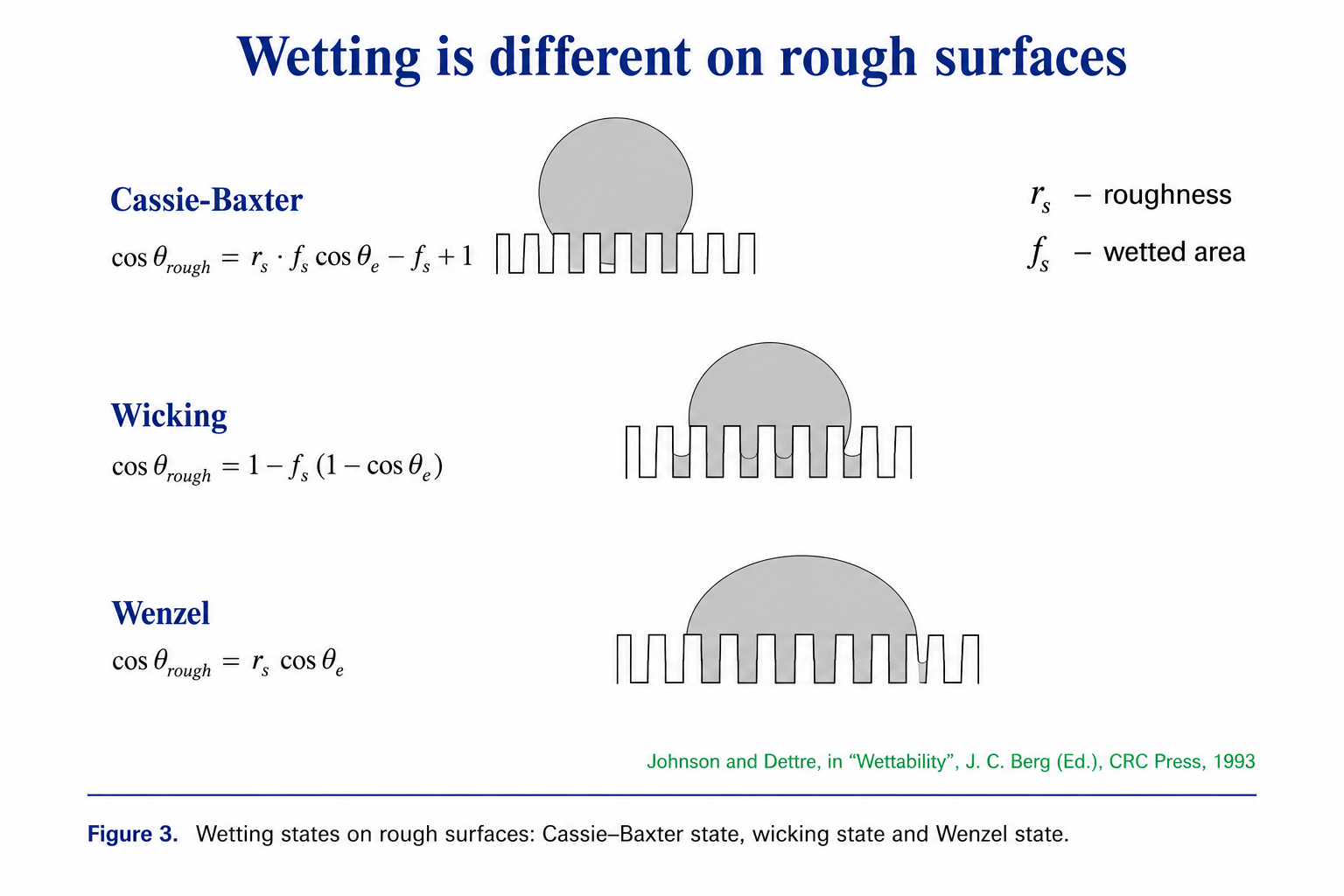
The Miller lecture emphasizes that wetting is different on rough surfaces and presents Wenzel, Cassie-Baxter and wicking as distinct scenarios. Roughness modifies both the true solid-liquid contact area and the configuration of the liquid beneath the apparent contact plane. [P1, 2, 3, 4]
02 · Wenzel state
Complete liquid penetration into surface topography
In the Wenzel state, the liquid follows the surface topography so that the entire roughness is wetted. Wenzel's classical relation connects the apparent contact angle θ_W to the Young angle θ_Y through the roughness ratio r, defined as the true wetted area divided by the projected area. [P1, 1, 4, 2]
Wenzel relation
r ≥ 1 for a rough surface.
The equation predicts that roughness amplifies the intrinsic tendency of the surface: a hydrophilic Young surface becomes more hydrophilic and a hydrophobic Young surface becomes more hydrophobic. The model assumes complete liquid penetration into the roughness and a geometrically meaningful roughness ratio. [P1, 2]
03 · Cassie-Baxter state
A composite interface beneath the droplet
In a Cassie-Baxter state, the droplet rests on a composite interface. For a textured hydrophobic surface, part of the apparent contact area is solid while another fraction may be trapped air. The effective apparent angle is determined by the area fractions and the contact angles associated with the individual components. [P1, 3, 4, 6]
Cassie-Baxter relation
For a solid-air composite beneath a water droplet, one component is effectively the liquid-air contact with cos 180° = -1. [P1]
A common special form for a solid fraction f_s and trapped air is cos θ_CB = f_s(cos θ_Y + 1) - 1. Low solid fraction can therefore produce very high apparent contact angles. [P1, 4, 6, 13]
04 · Metastability
Wenzel and Cassie-Baxter are limiting states
The Wenzel and Cassie-Baxter models should be regarded as limiting states, not a complete classification of every rough surface. Real droplets can partially infiltrate texture, become pinned at intermediate states, or transition from Cassie-like to Wenzel-like wetting under pressure, vibration or evaporation. [P1, 2, 3, 4]
This is one reason why high contact angle alone does not define a robust superhydrophobic surface. A metastable Cassie-Baxter state may collapse under small perturbations, producing large hysteresis and irreversible wetting of the texture. [P1, 3, 6, 11]
05 · Wicking
Capillary uptake into grooves and pores
Highly wettable rough or porous structures can draw liquid into grooves and pores by capillary action. In this wicking regime, a macroscopic sessile-drop angle may no longer capture the relevant wetting process. The dynamics are governed by capillary pressure, viscous resistance and pore geometry. [P1, 5, 15, 13]
References
Scientific literature
- 1.R. N. Wenzel, Resistance of Solid Surfaces to Wetting by Water, Industrial & Engineering Chemistry 28 (1936) 988-994. DOI: 10.1021/ie50320a024.
- 2.A. B. D. Cassie and S. Baxter, Wettability of Porous Surfaces, Transactions of the Faraday Society 40 (1944) 546-551. DOI: 10.1039/TF9444000546.
- 3.A. W. Neumann and J. K. Spelt (Eds.), Applied Surface Thermodynamics, Surfactant Science Series, Vol. 63, Marcel Dekker, 1996.
- 4.M. Ferrari, L. Liggieri and R. Miller (Eds.), Drops and Bubbles in Contact with Solid Surfaces, Progress in Colloid and Interface Science, CRC Press, 2013.
- 5.J. C. Berg (Ed.), Wettability, Surfactant Science Series, Marcel Dekker, 1993.