
01 · Thermodynamic basis
Interfacial free energies at three-phase contact
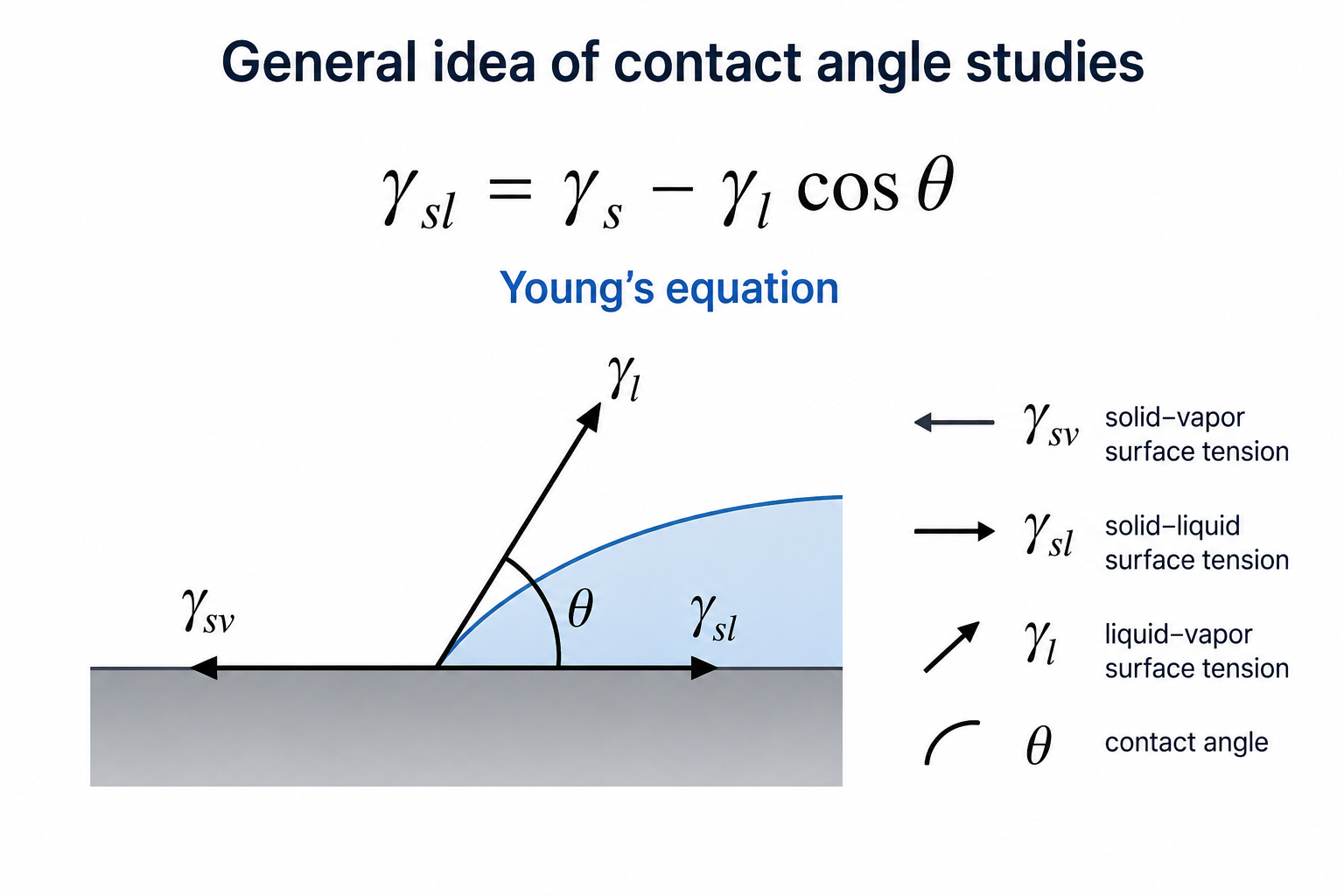
Consider a liquid droplet resting on a rigid solid in a vapor. Displacing the three-phase contact line by an infinitesimal distance changes the areas of the solid-vapor and solid-liquid interfaces while the liquid-vapor interface changes according to droplet geometry. At equilibrium, the first variation of total interfacial free energy with respect to the contact-line displacement must vanish. [P1, 1, 4]
Young equation
Equivalently, cos θ_Y = (γ_SV - γ_SL)/γ_LV. The angle θ_Y is measured through the liquid. This relation is a force-balance representation of an equilibrium free-energy condition, not a constitutive equation for the solid surface energy by itself. [P1, 5, 6]
02 · Young angle
Interpretation of the Young angle
When γ_SV - γ_SL is positive and large relative to γ_LV, cos θ is large and the liquid wets strongly. When the difference is smaller, the angle increases. A contact angle below 90 degrees is conventionally described called as partial wetting with relatively favorable liquid-solid contact; an angle above 90 degrees is described named as poor wetting or non-wetting. The Miller’s lecture explicitly classifies contact angles above 90 degrees as non-wetting and angles between 0 and 90 degrees as partial wetting. [P1, 4, 6, 13]
Complete wetting is qualitatively different. The equilibrium contact angle tends toward zero and an isolated equilibrium sessile droplet is no longer the appropriate state. Instead, the liquid spreads into a film. The lecture notes that in this regime only dynamic contact angles can be observed as the droplet spreads and the angle decreases toward zero. [P1, 5, 15, 4]
03 · Spreading coefficient
A complementary thermodynamic criterion
The spreading coefficient provides a complementary thermodynamic criterion. For a liquid on a solid in vapor, the coefficient S compares the free energy of the dry solid with that of a solid covered by a macroscopic liquid film. [P1]
Spreading coefficient
For S greater than or equal to zero, complete wetting is thermodynamically favored in the idealized macroscopic description. For S less than zero, a finite equilibrium contact angle is possible. Combining Young's equation with the definition of S gives S = γ_LV(cos θ_Y - 1), which is non-positive for any finite Young angle. [P1, 1, 4, 6]
04 · System property
Contact angle does not belong to the solid alone
The Young equation makes clear that θ does not belong to the solid alone. Changing the probe liquid changes γ_LV and γ_SL and therefore changes the angle. Likewise, changing the surrounding phase from air to oil changes the relevant interfacial tensions. A surface described as 'hydrophobic' by water contact angle can display very different behavior toward oils or low-surface-tension solvents. [P1, 1, 4, 6]
References
Scientific literature
- 1.T. Young, An Essay on the Cohesion of Fluids, Philosophical Transactions of the Royal Society of London 95 (1805) 65-87.
- 2.A. W. Neumann and J. K. Spelt (Eds.), Applied Surface Thermodynamics, Surfactant Science Series, Vol. 63, Marcel Dekker, 1996.
- 3.D. Möbius and R. Miller (Eds.), Drops and Bubbles in Interfacial Research, Studies in Interface Science, Vol. 6, Elsevier, Amsterdam, 1998.
- 4.M. Ferrari, L. Liggieri and R. Miller (Eds.), Drops and Bubbles in Contact with Solid Surfaces, Progress in Colloid and Interface Science, CRC Press, 2013.
- 5.J. C. Berg (Ed.), Wettability, Surfactant Science Series, Marcel Dekker, 1993.