
01 · Physical meaning
Tangential deformation at nearly constant area
Interfacial shear rheology probes the resistance of an adsorption layer to tangential deformation. Unlike dilational rheology, ideal shear deformation leaves the interfacial area unchanged. The method therefore emphasizes lateral connectivity and two-dimensional flow resistance. [P1, 10, 11, 1]
A low-molecular-weight surfactant layer can have a measurable dilational modulus because area changes perturb adsorption, yet possess extremely low shear elasticity. A condensed lipid monolayer, polymer film, protein network or particle-laden interface can show a much stronger shear response because the layer can transmit tangential stress over macroscopic distances. [P1, 10, 11, 1]
02 · Complex shear modulus
Elastic storage and dissipative response
Complex interfacial shear modulus
G_s′ represents elastic storage under shear and G_s″ the dissipative component. An interfacial shear viscosity can be related to the loss component through division by angular frequency in the linear oscillatory regime. As in dilational rheology, the measured response can depend on frequency and on the age and composition of the layer. [P1, 4, 5, 10]
03 · Sensitivity to interfacial structure
Weak and emerging networks
Shear rheology is particularly sensitive to weak or emerging networks. Small deflections are essential because large strain can rupture or reorganize the very structure being measured. The source material emphasizes this design philosophy for the SINTERFACE ISR-1: highly sensitive measurements are performed with small deflections to avoid breaking interfacial structures. [P1, 10, 11, 1]
04 · Torsion-pendulum shear rheometry
Generation of a tangential shear field
A torsion-pendulum rheometer uses a measuring body coupled to a torsion wire and positioned at the interface. A small angular displacement generates a tangential shear field. The restoring and dissipative torques produced by the interface modify the motion of the measuring body. [P1, 10, 11]
The method must separate interfacial torque from bulk viscous drag. This requires an accurate hydrodynamic model and calibration of the mechanical system. Because interfacial stresses can be extremely small, low-friction suspension and sensitive angular detection are essential. [P1]
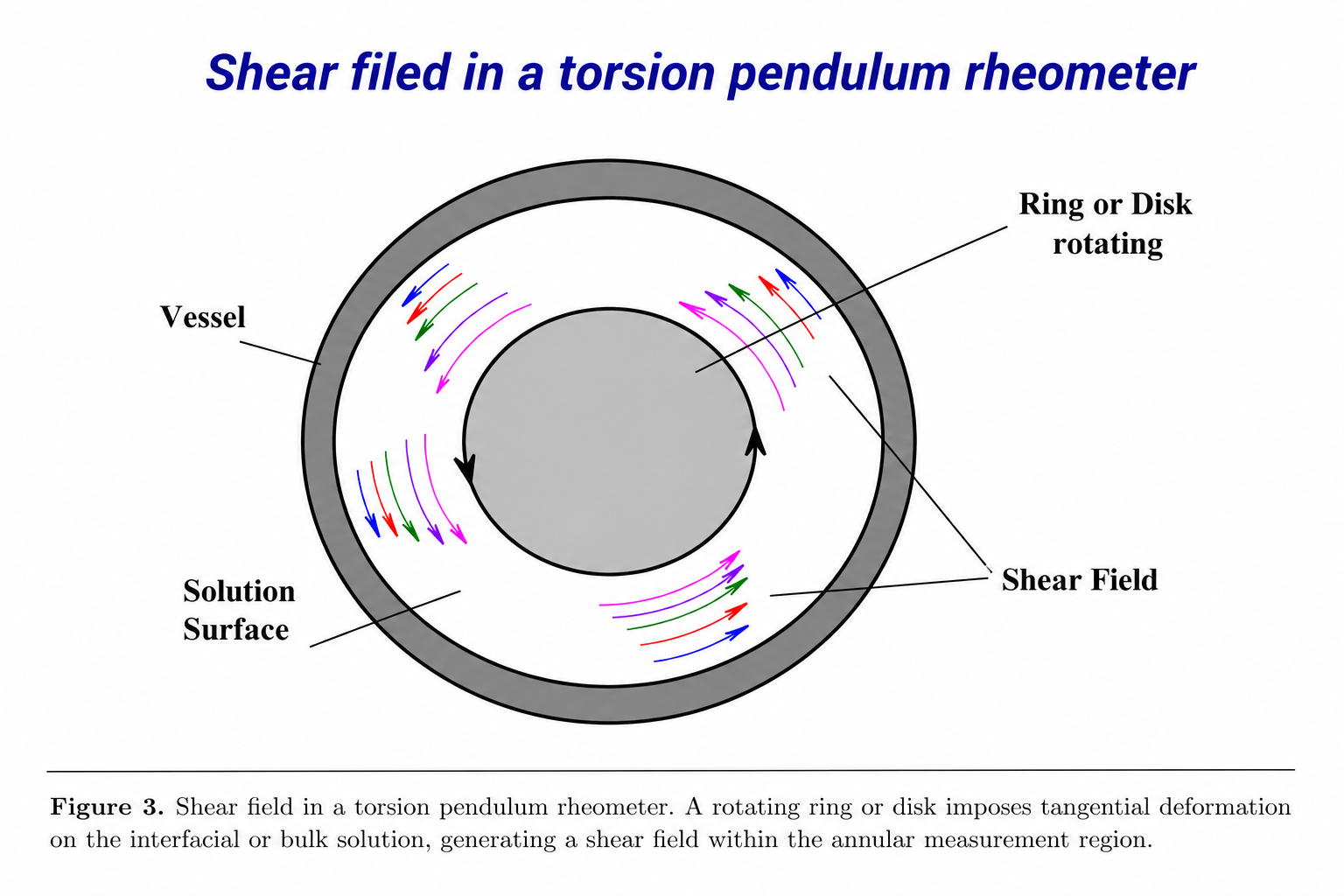
The source material cites the automated apparatus described by Krägel, Siegel, Miller, Born and Schano in 1994. The development of automated torsion rheometry made it possible to measure small-amplitude interfacial shear elasticity and viscosity reproducibly over long adsorption times. [P1, 10, 11, 1]
For oscillatory torsion measurements, Fourier analysis separates the fundamental response from noise and higher harmonics. The Miller’s lecture describes the ISR-1 as obtaining results through Fourier analysis. This is particularly useful when the angular deflections are intentionally kept very small. [P1, 9, 13, 10]
05 · Method selection
Choosing a shear-rheology method
For weak adsorption layers, dedicated torsion-wire or torsion-pendulum instruments provide high sensitivity at small deflection. For stronger films, conventional rotational rheometers equipped with interfacial geometries can offer broader strain and frequency control. The expected shear modulus, bulk viscosity, interface accessibility and risk of structural damage determine the appropriate instrument. [P1, 4, 5, 10]
The source lecture emphasizes small deflections for the ISR-1 specifically to avoid breaking structures. This principle is general: the method should perturb the interface enough to generate a measurable signal but not enough to change the structure being characterized. [P1]
The Miller’s lecture identifies the SINTERFACE ISR-1 as a sensitive surface and interfacial shear rheometer. Its key methodological characteristics are small deflections, preservation of fragile structures and Fourier-based signal analysis. It is therefore intended for adsorption layers whose shear response would be difficult to resolve with conventional bulk-rheometer geometries. [P1, 10, 11, 1]
References
Scientific literature
- 1.R. Miller and L. Liggieri (Eds.), Interfacial Rheology, Progress in Colloid and Interface Science, Vol. 1, Taylor & Francis, 2009.
- 2.J. Krägel, S. Siegel, R. Miller, M. Born and K.-H. Schano, Measurement of Interfacial Shear Rheological Properties: An Automated Apparatus, Colloids and Surfaces A 91 (1994) 169-180.
- 3.A. Maestro, F. Ortega, F. Monroy, J. Krägel and R. Miller, Surface shear rheological properties of poly(methyl methacrylate) Langmuir films: comparison between two different surface shear rheometers, Langmuir 25 (2009) 7393.
- 4.D. Möbius and R. Miller (Eds.), Drops and Bubbles in Interfacial Research, Studies in Interface Science, Vol. 6, Elsevier, Amsterdam, 1998.