
01 · Film formation
Approach, deformation and the creation of a liquid film
When two bubbles or droplets approach one another, the liquid trapped between the interfaces must be displaced. A liquid film forms between the approaching interfaces and begins to drain toward the surrounding meniscus. [P1, P2, P3, 1, 2]
The approach process can generate a dimple because drainage from the central region is slower than drainage near the film rim. The film therefore develops a spatially varying thickness profile before continued drainage produces progressively thinner regions. [P1, P3, 1, 2]
Model experiments with isolated drops or bubbles allow this sequence to be investigated independently of the structural complexity present in a complete foam or emulsion. [P1, P2, 1, 2]
02 · Film thinning
From interference colors to black-film formation
During thinning, optical interference colors provide a direct indication of the changing film thickness. As the film becomes progressively thinner, the interference pattern evolves from colored thick-film regions toward much darker states. [P1, P3, 1, 2]
Local black spots can nucleate within the thinning film. These regions represent transitions to substantially smaller film thickness. Depending on the interaction forces and applied conditions, the black region can grow into a stable black film or become involved in subsequent rupture. [P1, P3, 1, 2]
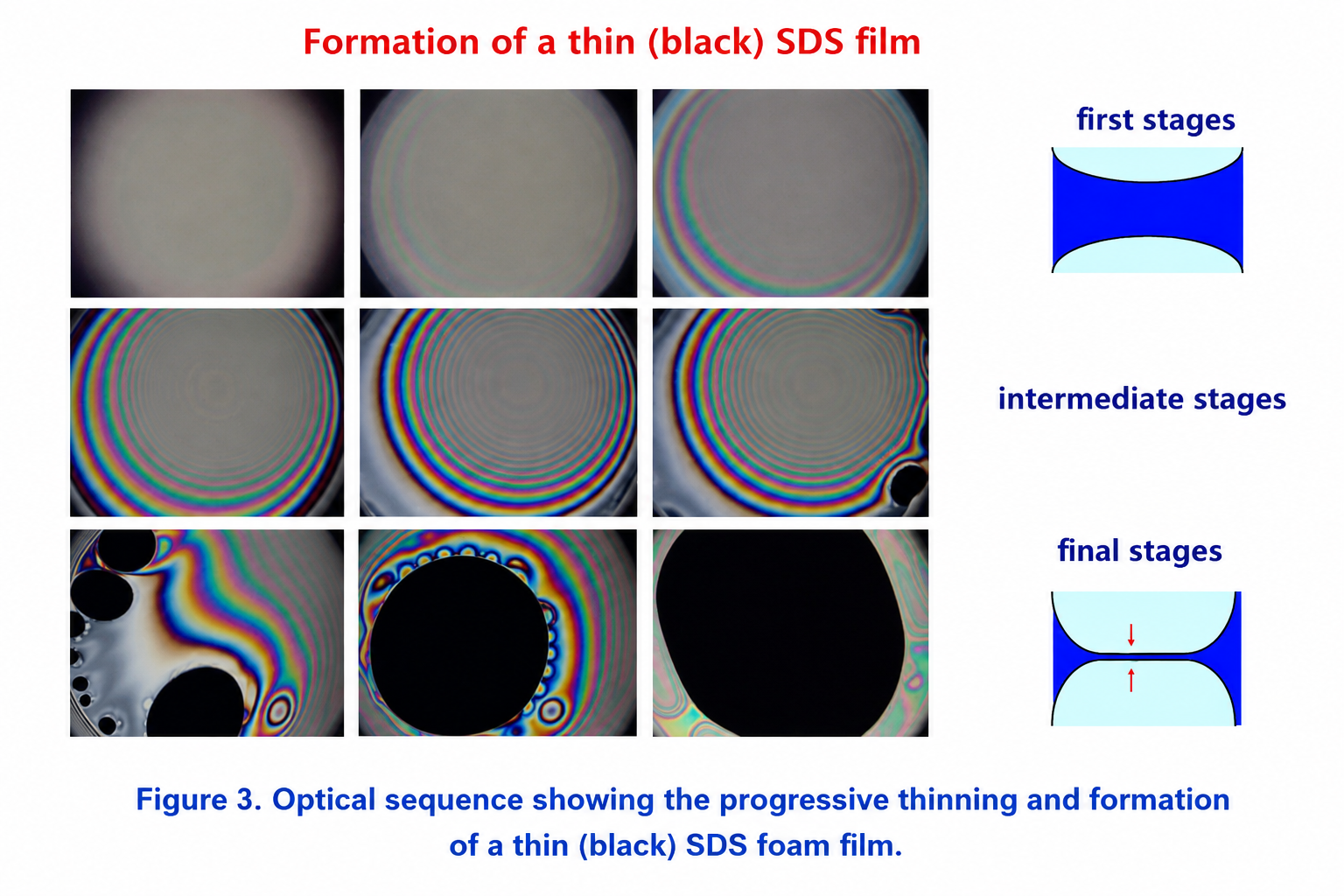
The sequence from thick-film drainage through interference fringes to black-film formation illustrates that film evolution is a continuous dynamic process rather than a transition determined by surface tension alone. [P1, P3, 1, 2]
03 · Film stability
Critical thickness and the onset of instability
A thinning film can become unstable when restoring interaction forces are no longer sufficient to suppress thickness fluctuations. The corresponding critical condition depends on the disjoining-pressure relation, capillary pressure, film radius and hydrodynamic state. [P1, P3, 1, 2]
Critical thickness should therefore not be interpreted as a universal intrinsic constant of a formulation. The observed value depends on geometry, applied pressure, drainage history, interfacial composition and experimental conditions. [P1, P3, 1, 2]
A film can also remain in a metastable condition for a finite time before a sufficiently large fluctuation initiates a local transition or rupture event. [P1, P3]
04 · Film failure
Rupture can be deterministic or stochastic
Film rupture can follow a deterministic instability associated with the interaction-pressure isotherm and hydrodynamic evolution of the film. In this case, thickness fluctuations grow because the homogeneous film state becomes mechanically unstable. [P1, P3, 1, 2]
Real films can also rupture through stochastic nucleation. Dust particles, aggregates, local adsorption defects or thermal fluctuations can initiate a rupture event even under nominally identical experimental conditions. [P1, P2, 1, 2]
Film lifetime therefore frequently displays statistical variation. A single measured rupture time should not be interpreted independently of pressure, film size, drainage protocol and sample history. [P1, P3, 1, 2]
In systems capable of forming black films, black-spot nucleation may precede rupture. Whether the spot expands into a stable thin-film state or becomes associated with failure depends on the relative stability of the available film states. [P1, P3, 1, 2]
05 · Macroscopic consequence
Film rupture enables bubble or droplet coalescence
When the liquid film separating two neighboring bubbles ruptures, the two gas volumes can merge. The corresponding process in emulsions allows two droplets to coalesce. Thin-film rupture therefore provides the microscopic event connecting film stability with the stability of dispersed systems. [P1, P2, P3, 1, 2]
The Drop-Bubble Micro Manipulator provides a model system for studying this interaction directly. Controlled dosing, pressure sensing and positioning allow pairs of drops or bubbles to be brought together according to a defined interaction protocol while deformation and coalescence are observed. [P1, P2, 3, 1, 2]
Nevertheless, the lifetime of an isolated film cannot be equated directly with the lifetime of a complete foam or emulsion. Macroscopic systems additionally involve drainage, bubble or droplet rearrangement, gas diffusion and distributions of local film conditions. [P1, P2, 1, 2]
Single-film experiments are therefore model experiments. Their strength lies in isolating one essential step in the destabilization process so that the underlying physics can be characterized quantitatively. [P1]
References
Scientific literature
- 1.D. Exerowa and P. M. Kruglyakov, Foam and Foam Films: Theory, Experiment, Application, Elsevier, Amsterdam, 1998.
- 2.D. Exerowa, G. Gochev, D. Platikanov, L. Liggieri and R. Miller (Eds.), Foam Films and Foams: Fundamentals and Applications, CRC Press, 2018.
- 3.J. Y. Won, J. Krägel, A. V. Makievski, A. Javadi, G. Gochev, G. Loglio, P. Pandolfini, M. E. Leser, C. Gehin-Delval and R. Miller, Drop and Bubble Micro Manipulator (DBMM) – a unique tool for mimicking processes in foams and emulsions, Colloids and Surfaces A 441 (2014) 807–814.