
01 · Adsorption kinetics
A newly created interface evolves with time
When a clean or weakly populated interface is generated, surface-active molecules are initially located predominantly in the bulk. Molecules then diffuse or are transported by convection toward the interface, cross the subsurface region and adsorb.
The adsorption layer progressively lowers the interfacial free energy. At a fixed bulk concentration, the surface excess Γ therefore increases with time while γ usually decreases toward its equilibrium value.
Dynamic tension consequently reflects both molecular transport toward the interface and the organization of molecules within the interfacial layer.
02 · Transport
Transport from the bulk is the first requirement for adsorption
A molecule located far from a newly created interface must first reach the interfacial region. In a quiescent solution, molecular diffusion often provides the dominant transport mechanism.
A concentration gradient develops because molecules are removed from the subsurface as they adsorb. This gradient drives further diffusive flux toward the interface.
The characteristic diffusion time depends on the square of the transport distance divided by the diffusion coefficient. Small surfactants can therefore respond on much shorter timescales than larger molecules such as proteins or polymers.
Higher bulk concentration also increases the molecular flux available to populate a new interface. Dynamic surface-tension curves therefore usually approach equilibrium more rapidly as surfactant concentration increases.
03 · Convective transport
Interface formation can modify the transport field
Many tensiometric and industrial processes are not perfectly quiescent. Formation of a bubble or drop displaces liquid and can create convection near the interface.
Rapid gas flow in bubble-pressure tensiometry, liquid inflow during drop growth or bulk recirculation around a rising bubble can alter molecular transport. The observed adsorption kinetics can therefore deviate from purely diffusive predictions even when no explicit mixing is imposed.
Convection is not automatically an artefact. In a process-simulation experiment it may represent a physically relevant part of the interfacial history. Interpretation must therefore match the experimental objective.
04 · Interfacial kinetics
Arrival at the interface does not guarantee immediate adsorption
Molecules can encounter an energetic barrier associated with dehydration, electrostatic repulsion, steric constraints or the need to reorient before incorporation into a dense adsorption layer.
If this interfacial step is slow relative to diffusion, the adsorption process becomes kinetically controlled or mixed controlled.
For ionic surfactants, electrostatic effects are particularly important. As charged molecules adsorb, an interfacial electric potential can develop and oppose further adsorption of like-charged species.
Added electrolyte screens this repulsion and can accelerate adsorption. A system that appears kinetically limited at low ionic strength may therefore approach diffusion control after salt is added.
05 · Molecular organization
The interface can continue to evolve after adsorption
The tension can continue to change even after molecules have reached the interface. Adsorbed molecules may reorient, unfold, aggregate or displace other components.
For low-molecular-weight surfactants these structural relaxations may be rapid, whereas for proteins and polymers they can dominate the long-time dynamics.
In mixed systems, one component can adsorb rapidly and later be replaced by another component with higher equilibrium affinity.
A monotonic decrease in γ therefore does not uniquely reveal which microscopic mechanism is rate limiting.
06 · Diffusion-controlled adsorption
The Ward–Tordai framework
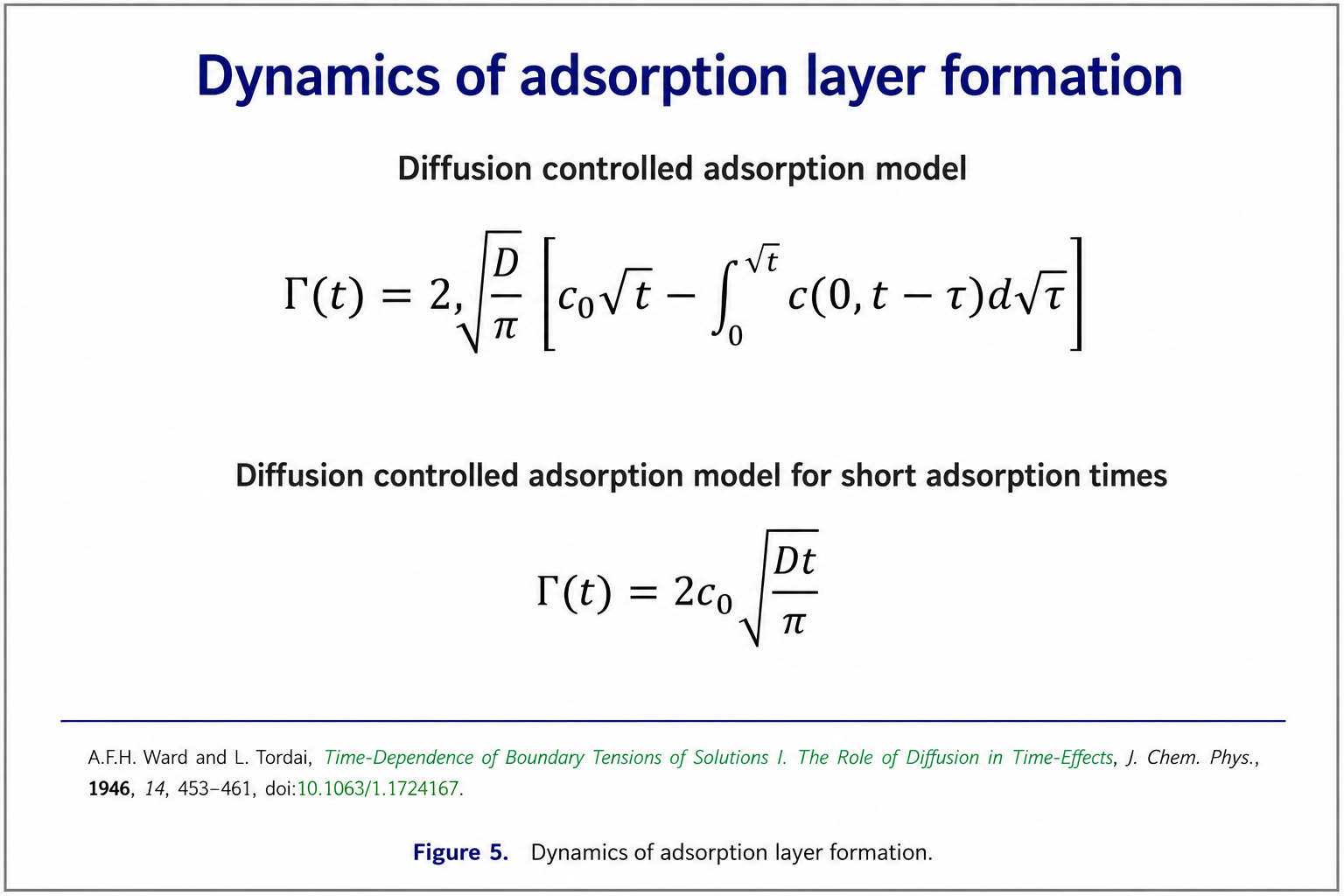
Ward and Tordai formulated the classical theory of diffusion-controlled adsorption to a newly created interface. The model considers depletion of solute near the interface as molecules adsorb and includes the possibility of back-diffusion from the subsurface region.
Ward–Tordai equation — common form
c₀ is the bulk concentration, D the diffusion coefficient and cₛ the time-dependent subsurface concentration.
The first term represents the maximum diffusive delivery that would occur if molecules arriving at the interface were irreversibly removed without changing the subsurface boundary condition.
The integral term accounts for the evolving concentration near the interface and the possibility of molecules returning to the bulk.
Closure of the transport problem requires an adsorption isotherm or kinetic boundary condition that relates the subsurface concentration to the surface excess.
07 · Short-time limit
Surface excess initially follows a square-root-of-time relation
At very short times, when the interface is far from saturation and the subsurface concentration has not changed strongly, the back-diffusion term is small.
Short-time diffusion limit
The surface excess then grows approximately with the square root of time.
This √t dependence is frequently used as a diagnostic for diffusion-controlled adsorption, but it must be applied cautiously. Experimental time resolution, uncertain surface age and the process of interface formation itself can obscure the earliest regime.
A square-root trend over a narrow interval is therefore suggestive but is not sufficient to demonstrate that all later adsorption remains diffusion controlled.
08 · Experimental interpretation
Surface excess and tension are not the same observable
The Ward–Tordai equation predicts surface excess rather than surface or interfacial tension.
A thermodynamic equation of state is required to convert Γ(t) into γ(t). For a dilute ideal adsorption layer the relation may be simple, whereas realistic surfactant layers can require Langmuir, Frumkin, reorientation or aggregation models.
The combined description therefore contains two distinct parts: transport determines the evolution of Γ, while interfacial thermodynamics determines how a given Γ maps to γ.
Two surfactants with similar diffusion coefficients can consequently produce very different dynamic surface-tension curves if the relation between surface excess and tension differs.
At longer times, the concentration gradient decreases as the interface approaches equilibrium. Desorption, back-diffusion, interfacial interactions and slow structural relaxation become increasingly important. A short-time asymptotic relation should therefore not be used to fit an entire γ(t) curve outside the range in which its assumptions are valid.
10 · References
Scientific literature
- 1.A. F. H. Ward and L. Tordai, Time-dependence of boundary tensions of solutions. I. The role of diffusion in time-effects, Journal of Chemical Physics 14 (1946) 453–461. DOI: 10.1063/1.1724167.
- 2.R. Miller and L. Liggieri (Eds.), Interfacial Rheology, Progress in Colloid and Interface Science, Vol. 1, 2009.
- 3.J. Lucassen and M. van den Tempel, Dynamic measurements of dilational properties of a liquid interface, Chemical Engineering Science 27 (1972) 1283–1291.
- 4.J. Lucassen and M. van den Tempel, Longitudinal waves on visco-elastic surfaces, Journal of Colloid and Interface Science 41 (1972) 491–498.
- 5.A. Javadi, J. K. Ferri, T. D. Karapantsios and R. Miller, Interface and bulk exchange: single drop experiments and CFD simulations, Colloids and Surfaces A 365 (2010) 145.
- 6.V. B. Fainerman, D. Möbius and R. Miller (Eds.), Surfactants: Chemistry, Interfacial Properties, Applications, Studies in Interface Science, Vol. 13, Elsevier, Amsterdam, 2001.