
01 · Measurement principle
Dynamic tension from a growing bubble
Maximum bubble pressure tensiometry is one of the most important techniques for dynamic surface tension at short interfacial ages.
Gas is driven through a capillary immersed in the liquid. A bubble grows at the capillary tip, and the pressure in the gas system changes as the bubble curvature evolves.
The pressure reaches a characteristic maximum when the geometry at the capillary tip is approximately hemispherical. At this point, the capillary pressure contribution is related to surface tension through the Young–Laplace relation.
02 · Pressure maximum
Curvature connects pressure and surface tension
Young–Laplace pressure for a spherical interface
If the radius of curvature at the pressure maximum is equal to the capillary radius r under the idealized geometry, the capillary pressure is approximately 2γ/r.
Real instruments require more detailed correction because the measured pressure contains several contributions and the bubble-growth dynamics may deviate from the simplest spherical picture.
03 · Pressure balance
The measured pressure is not purely capillary pressure
The measured pressure contains capillary, hydrostatic and hydrodynamic contributions. Hydrostatic pressure arises from the depth of the capillary tip below the free liquid surface, while hydrodynamic pressure reflects liquid and gas motion.
The pneumatic response of tubing and the measuring volume can add further dynamic effects.
Conceptual pressure balance
The exact correction scheme depends on instrument geometry and operating conditions.
At very short bubble times, hydrodynamic and pneumatic effects can become comparable to the capillary pressure difference being used to infer γ.
A device can therefore display an apparent dynamic tension for pure water even though pure water has no adsorption process responsible for such a time dependence.
04 · Interfacial age
Bubble time, deadtime and surface lifetime must be distinguished
A defining feature of rigorous bubble-pressure analysis is the distinction between bubble time, deadtime and surface lifetime.
The bubble time t_b is the total period between equivalent points of successive bubble cycles. It can be divided into the lifetime t_l of the relevant expanding interface and a deadtime t_d associated with the interval after the pressure maximum or detachment during which the next measurable interface is not yet in the same stage.
Bubble-period decomposition
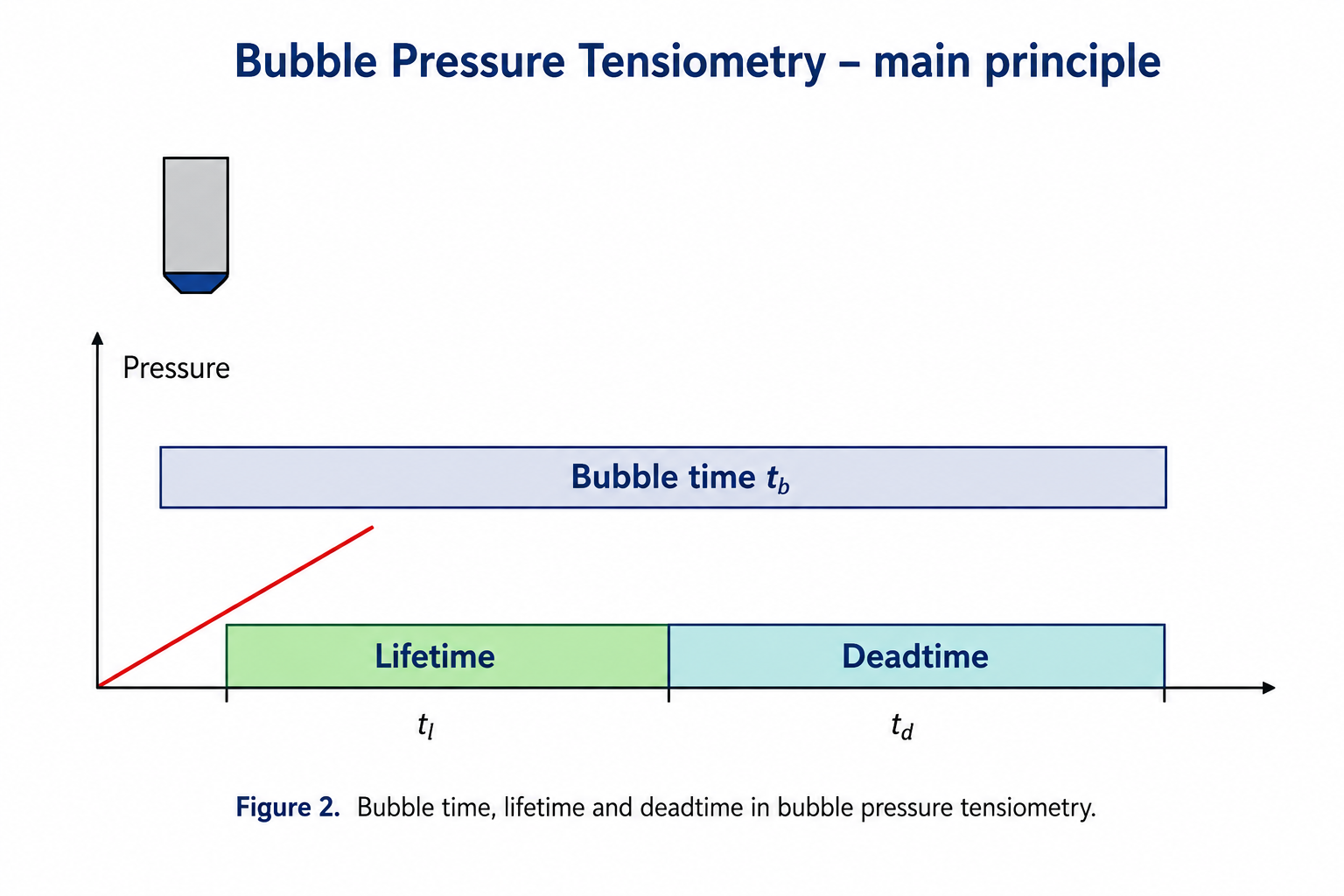
The surface lifetime relevant to the pressure maximum is therefore obtained from t_l = t_b − t_d, rather than by identifying the entire bubble period with surface age.
Short-time adsorption curves are highly sensitive to even small errors in the assigned interfacial age.
05 · Viscosity
Deadtime is not a universal instrument constant
The lecture data show that deadtime depends strongly on liquid viscosity. Bubble detachment, capillary refill and hydrodynamic relaxation all slow down as viscosity increases.
Data illustrated for viscosities spanning approximately 1 to more than 50 mPa s demonstrate that deadtime cannot be treated as a universal instrument constant.
The consequence for dynamic surface tension can be substantial. In the lecture example for C12DMPO solutions, different effective deadtimes lead to differences in measured dynamic tension on the order of 10 mN/m.
At the shortest surface ages, this error can be comparable to or larger than the kinetic effects being investigated.
06 · Measuring system
Pneumatic volume influences the pressure response
The apparent dynamic tension can also depend on the pneumatic volume of the measuring system. A larger gas reservoir changes the pressure-flow response and can distort the pressure maximum if the system is interpreted with an oversimplified static model.
Pure-water experiments provide an effective diagnostic because any observed age-dependent tension is then attributable to measurement dynamics rather than surfactant adsorption.
High-quality maximum bubble pressure measurements require fast pressure sensing, well-characterized gas flow, small and controlled pneumatic volume, precise capillary geometry and an analysis capable of separating hydrodynamic contributions from the desired capillary pressure.
07 · Experimental range
Access to the earliest adsorption regime
The principal strength of maximum bubble pressure tensiometry is access to the earliest adsorption regime.
The Miller lectures identify it as the most frequently used dynamic surface-tension technique and emphasize its ability to reach below one millisecond.
This time window is essential for distinguishing rapid adsorption mechanisms and for simulating fast processes such as spraying, printing and high-speed foam generation.
Experimental limitations
The same speed that makes bubble-pressure tensiometry powerful also makes it experimentally demanding. Hydrodynamic corrections, surface-age definition, capillary wetting, viscosity, gas flow and pneumatic volume all matter.
Extrapolating short-time bubble-pressure data to equilibrium can also be unreliable because slow adsorption or relaxation processes may lie entirely outside the measured time window.
09 · References
Scientific literature
- 1.R. Miller and L. Liggieri (Eds.), Bubble and Drop Interfaces, Progress in Colloid and Interface Science, Vol. 2, Brill, Leiden/Boston, 2011.
- 2.V. B. Fainerman and R. Miller, Maximum Bubble Pressure Tensiometry: Theory, Analysis of Experimental Constraints and Applications, in: R. Miller and L. Liggieri (Eds.), Bubble and Drop Interfaces, 2011, pp. 75–118. DOI: 10.1163/ej.9789004174955.i-558.38.
- 3.J. Meissner, J. Krägel, C. Frese, S. Rupert, V. B. Fainerman, A. V. Makievski and R. Miller, Comparative studies of the dynamic surface pressure of C12EO6 solutions performed using different maximum bubble pressure tensiometers, SÖFW-Journal 130 (2004) 41–46.
- 4.V. B. Fainerman and R. Miller, Maximum bubble pressure tensiometry – an analysis of experimental constraints, Advances in Colloid and Interface Science 108–109 (2004) 287–301. DOI: 10.1016/j.cis.2003.10.010.