
01 · Molecular environment
Surface tension is simultaneously a thermodynamic, molecular and mechanical property
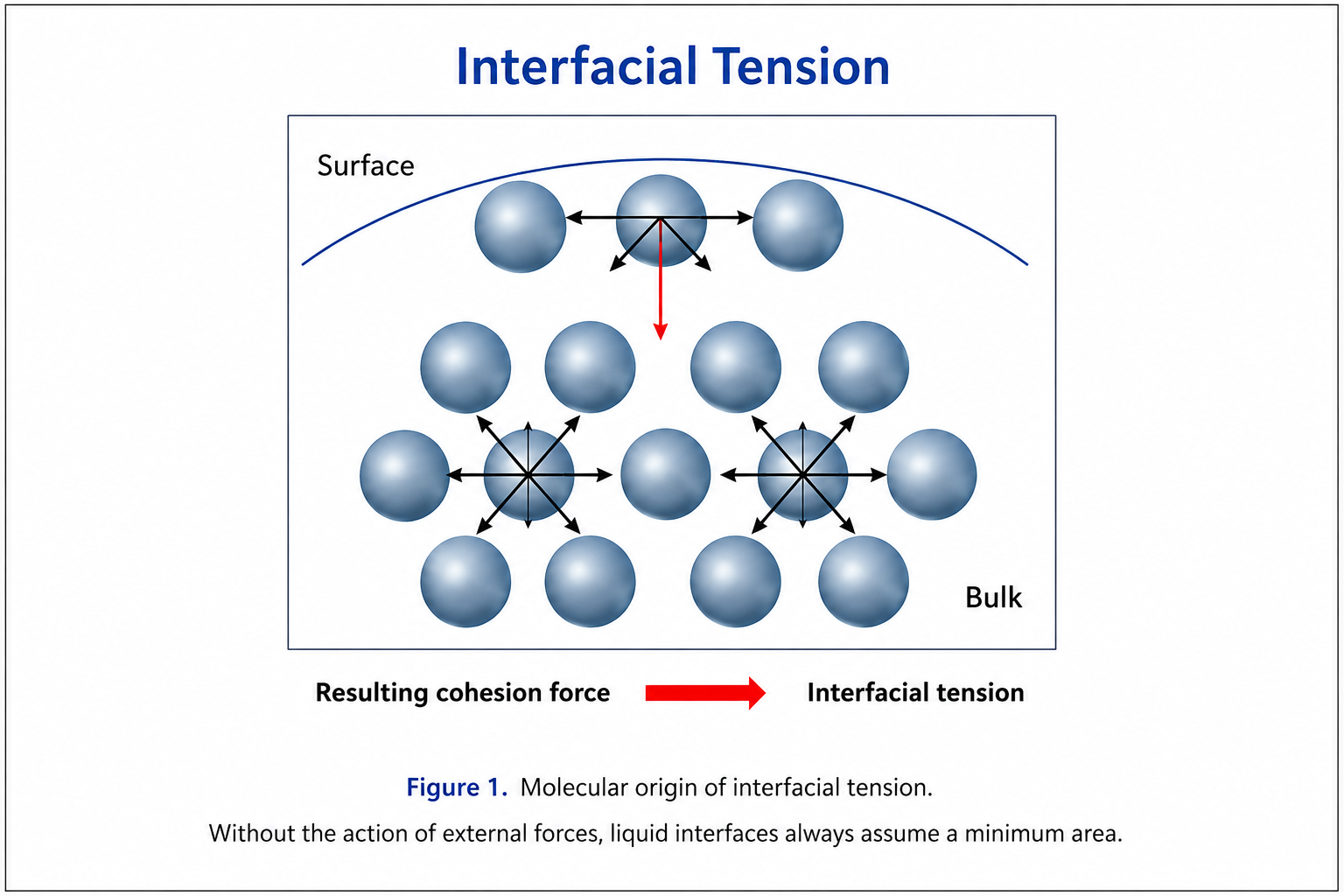
Any macroscopic sample of liquid contains molecules in energetically different environments. A molecule deep in a homogeneous phase is surrounded by neighboring molecules in all spatial directions.
A molecule located in the interfacial region experiences an anisotropic environment because the composition and density on one side differ from those on the other. The interfacial region therefore possesses an excess free energy relative to the corresponding amounts of bulk material.
The system reduces this energetic contribution by minimizing interfacial area whenever external constraints do not prevent it. This tendency explains why sufficiently small free drops and bubbles approach spherical shapes: at fixed volume, the sphere has the minimum possible area.
02 · Molecular origin
Why creating an interface requires work
The molecular origin of interfacial free energy can be understood without assigning a literal inward force to each surface molecule.
What matters is that moving molecules from the bulk into an interfacial environment changes their interactions and entropy.
The resulting excess free energy is integrated over a finite interfacial region whose thickness is molecular rather than macroscopic.
Thermodynamics replaces this spatially diffuse region by an idealized dividing surface and attributes excess quantities—including adsorption—to that surface.
03 · Molecular interactions
Cohesive interactions, molecular structure and thermal motion
The magnitude of surface tension reflects the balance of cohesive interactions, molecular structure and thermal motion.
Strongly cohesive liquids generally display larger surface tensions than weakly interacting liquids, while increasing temperature normally reduces γ because the density and energetic contrast between phases decreases.
Approaching a critical point, the distinction between the coexisting phases vanishes and the interfacial tension tends toward zero.
04 · Multicomponent interfaces
Interfacial localization
In a multicomponent liquid, molecules that reduce the interfacial free energy preferentially populate the interface. Surfactants provide the canonical example.
Their amphiphilic architecture combines chemical groups with different affinities for the adjacent phases, making interfacial localization energetically favorable.
At a water–air interface, a typical surfactant orients its hydrophilic moiety toward water while its hydrophobic moiety avoids the aqueous bulk.
At a water–oil interface, both sides offer molecular environments and adsorption can couple to partitioning into the oil phase.
06 · References
Scientific literature
- 1.J. W. Gibbs, The Collected Works of J. Willard Gibbs, Vol. 1: Thermodynamics, Longmans, Green and Co., 1928.
- 2.A. I. Rusanov and V. A. Prokhorov, Interfacial Tensiometry, Studies in Interface Science, Vol. 3, Elsevier, Amsterdam, 1996.
- 3.V. B. Fainerman, D. Möbius and R. Miller (Eds.), Surfactants: Chemistry, Interfacial Properties, Applications, Studies in Interface Science, Vol. 13, Elsevier, Amsterdam, 2001.