
01 · Fundamentals
Surface tension
The term surface tension is conventionally used when one phase is a gas, usually air or the vapor of the liquid.
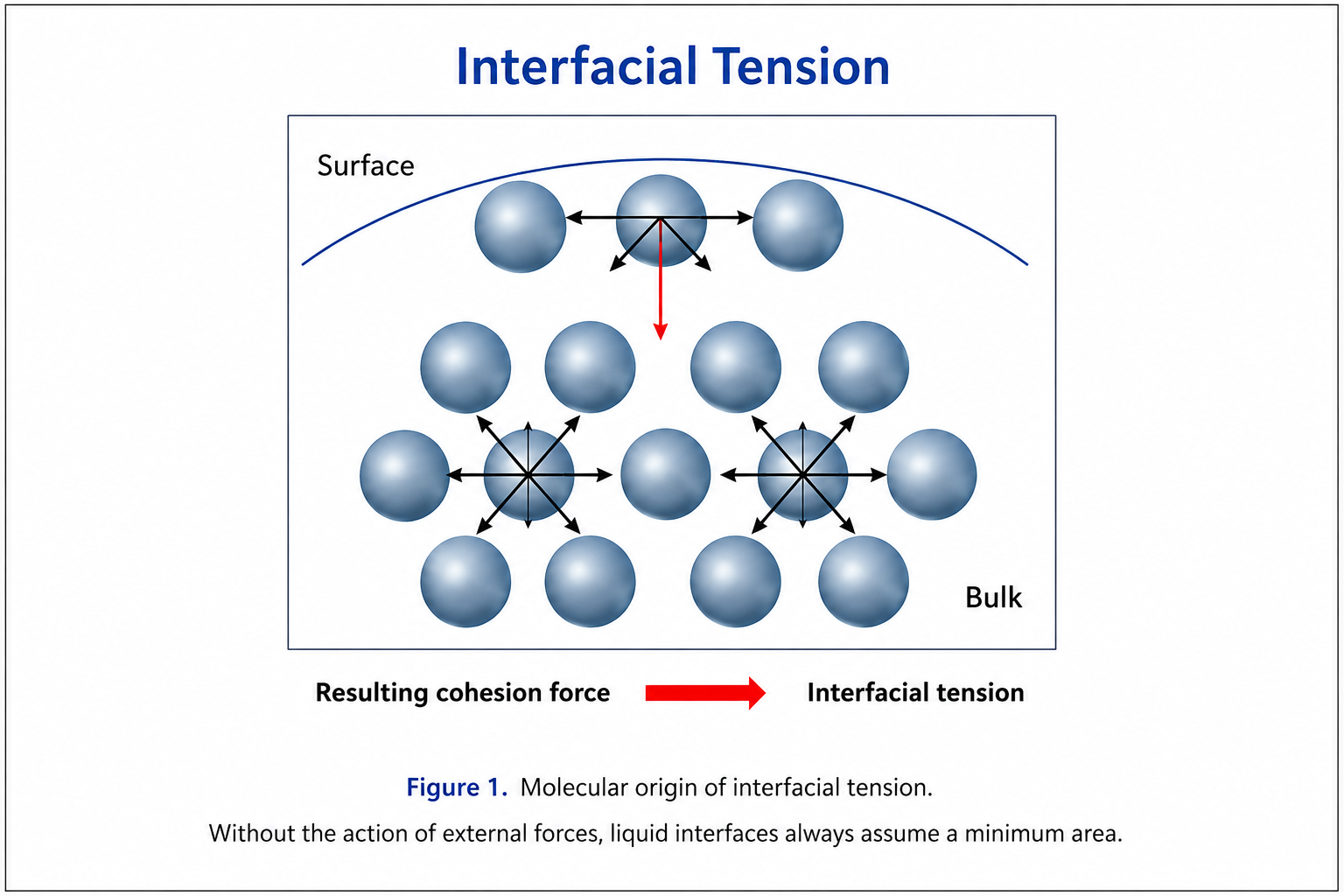
For a pure liquid at equilibrium, surface tension reflects the energetic penalty associated with moving molecules from the bulk to an interface where their intermolecular environment is incomplete and anisotropic.
02 · Fundamentals
Surface tension versus interfacial tension
The term surface tension is conventionally used when one phase is a gas, usually air or the vapor of the liquid. Interfacial tension refers to the boundary between two condensed phases, most commonly two immiscible liquids such as water and oil.
Both quantities have the same thermodynamic meaning and the same unit. Their magnitudes differ because they depend on the contrast in molecular interactions across the boundary.
Water has a relatively high surface tension because hydrogen bonding and strong cohesive interactions make the transfer of molecules to the surface energetically expensive. At a water–hydrocarbon interface, however, molecules on both sides provide attractive interactions, so the energetic penalty is typically lower than at the water–air surface.
If two liquids become increasingly similar in polarity and cohesive energy density, their interfacial tension tends to decrease; close to a critical solution temperature it can approach zero as the distinction between the phases disappears.
03 · Physical meaning
Surface tension and interfacial area
A molecule in the interior of a homogeneous liquid is surrounded by neighboring molecules in every direction. Although the instantaneous forces fluctuate, the average environment is isotropic.
A molecule at the surface experiences a different condition: the liquid phase is present on one side, while the opposing phase—often air or vapor—has a much lower molecular density and a different interaction potential.
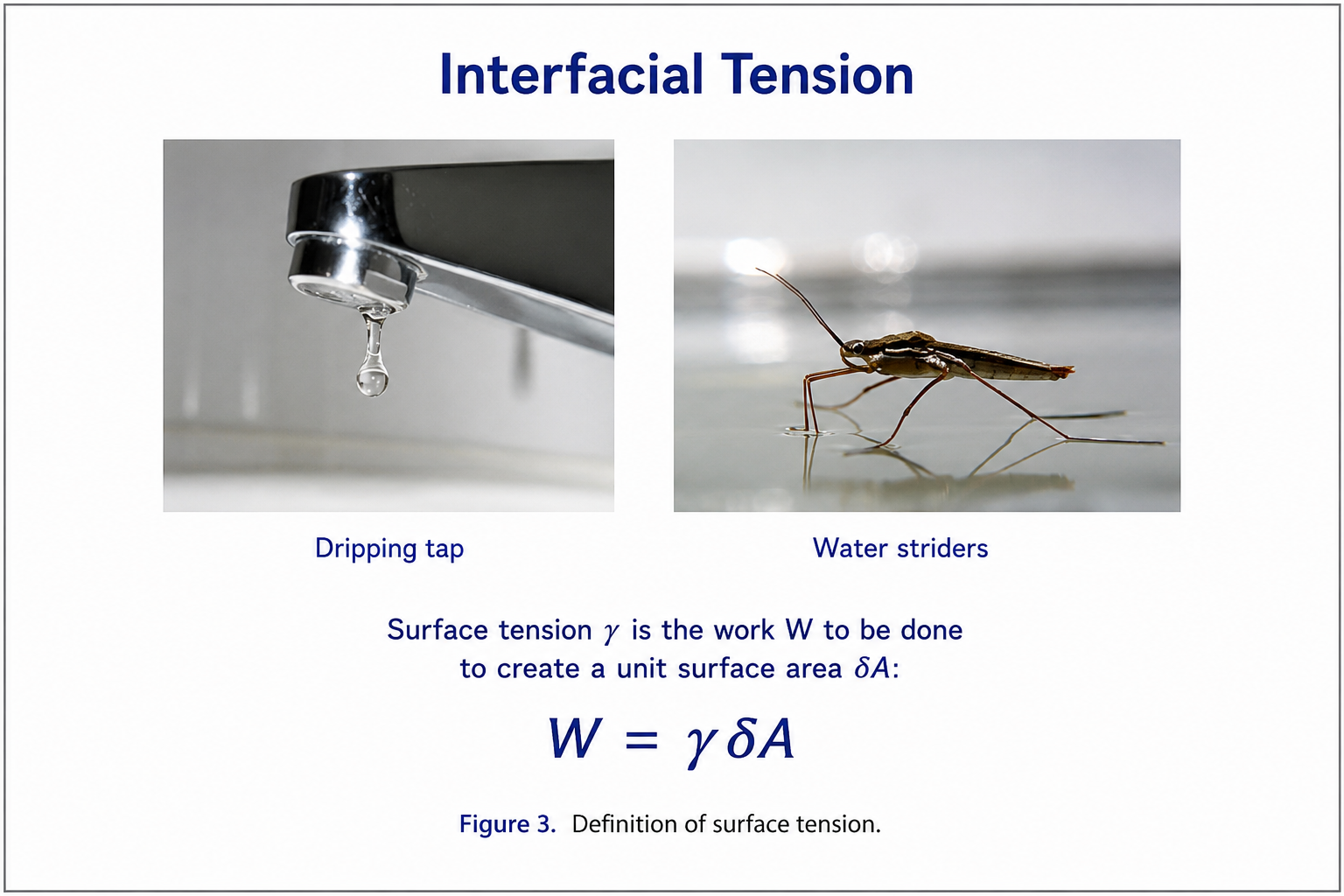
The resulting molecular environment is anisotropic. Creating additional surface therefore requires work because molecules must be transferred from their favorable bulk coordination into this less favorable interfacial region.
05 · References
Scientific literature
- 1.J. W. Gibbs, The Scientific Papers of J. Willard Gibbs, Vol. 1: Thermodynamics, Longmans, Green and Co., 1906; later collected editions.
- 2.A. I. Rusanov and V. A. Prokhorov, Interfacial Tensiometry, Studies in Interface Science, Vol. 3, Elsevier, Amsterdam, 1996.
- 3.D. Möbius and R. Miller (eds.), Drops and Bubbles in Interfacial Research, Studies in Interface Science, Vol. 6, Elsevier, Amsterdam, 1998.
- 4.R. Miller and L. Liggieri (eds.), Bubble and Drop Interfaces, Progress in Colloid and Interface Science, Vol. 2, CRC Press / Brill, 2011.
- 5.A. W. Adamson and A. P. Gast, Physical Chemistry of Surfaces, 6th ed., Wiley, New York, 1997.
- 6.J. N. Israelachvili, Intermolecular and Surface Forces, 3rd ed., Academic Press, 2011.